Are you looking for health data analysis training in Lagos? If so, your search ends here. Lagos Data School is Nigeria’s leading health data training centre. Hundreds of Nigerian health workers and analysts have been trained here. Every graduate leaves with the skills that Lagos hospitals, health-tech firms, and global health agencies demand. That is why Lagos Data School is rated the best health data training school in Nigeria.
So, this guide covers everything you need to know. It explains what health data analysis is and why it matters for Nigeria. In addition, it covers what Lagos Data School teaches at each level. Also, it shows what you can earn and who will hire you after training. As a result, by the end, you will have a clear plan to start your healthcare data career in Lagos.
So, Why Is Healthcare Data Analysis Important in Lagos in 2026?
Simply put, Nigerian hospitals generate millions of records every year. Patient files, lab results, and billing data are all collected daily. Yet much of this data stays unanalysed. Also, poor data work leads to missed diagnoses, drug shortages, and wasted budgets. So trained health data analysts are now seen as vital by Lagos hospitals and health agencies.
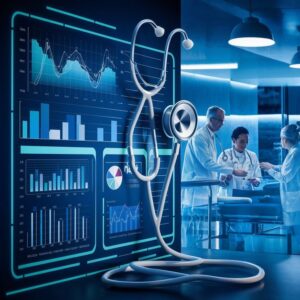
In addition, global health bodies like the WHO, USAID, and the World Bank fund large health projects here. Each of these projects runs on data. Analysts who know health data tools land these roles. Moreover, Lagos’ growing health-tech sector needs data-literate professionals at every level. As a result, health data analysis is one of the most in-demand skills in Nigeria’s health and tech sectors in 2026.
What Is Healthcare Data Analysis and What Does a Health Data Analyst Do?
In fact, health data analysis means collecting, cleaning, and studying health data to improve patient care. A health data analyst works with health records and datasets, and patient outcome reports. So their job is to find patterns and give decision-makers the facts they need.
Here is what a trained health data analyst in Lagos does every day:
- Cleans and structures patient data from hospital management systems.
- Builds dashboards to track hospital KPIs: bed occupancy, readmission rates, and drug use.
- Analyses disease trends and outbreak patterns using public health datasets.
- Produces mortality and morbidity reports for Lagos State health authorities.
- Evaluates drug trial outcomes and clinical study results using statistical tools.
- Supports grant reporting for WHO, USAID, and global health donor projects.
- Connects health data pipelines from EHR systems to analytics platforms.
- Presents findings to hospital leadership, medical staff, and policy makers.
Also, many senior health data analysts go on to lead data strategy for Nigerian hospitals or health-tech startups. In short, health data analysis is both a technical and an impact-driven career in Nigeria.
Key Healthcare Data Analysis Tools You Learn at Lagos Data School
At Lagos Data School, you learn the exact tools that Lagos hospitals and health agencies use in 2026. Here is the full health data tool stack that the course covers:
| Tool | Purpose in Healthcare | Level Taught |
| Microsoft Excel | Patient data entry, basic stats, pivot tables for health KPIs | Foundations |
| Power BI | Hospital dashboards, disease trend visuals, and health KPI reports | Intermediate |
| Python (pandas, matplotlib) | Data cleaning, statistical analysis, and health data visualisation | Intermediate |
| SQL | Querying EHR and hospital management system databases | Intermediate |
| SPSS | Clinical study stats: chi-square, ANOVA, regression for health research | Intermediate |
| R (for health research) | Epidemiology models, survival analysis, and public health datasets | Advanced |
| Tableau | Interactive public health maps and patient outcome dashboards | Intermediate |
| REDCap / DHIS2 | Research data capture and national health information systems | Intermediate |
Lagos Data School: The Home of Healthcare Data Analysis Training in Lagos
When it comes to health data analysis training in Lagos, Lagos Data School leads Nigeria. Indeed, it is the country’s most trusted health data training centre. Every instructor is a practising health data analyst, clinical researcher, or health informatics professional. So you learn from people who analyse real Nigerian patient data for real hospitals, NGOs, and donor agencies every day. Also, every course project uses real Nigerian health datasets. That is why Lagos Data School graduates are hired from day one.
In addition, Lagos Data School believes every Nigerian health worker deserves world-class data training. It must be hands-on and tied to real career results. So Lagos Data School designed its health data programme to take learners from beginner to job-ready in eight to sixteen weeks. As a result, graduates build real dashboards, write real reports, and land real health data roles.
To explore all health data and analytics courses, visit Lagos Data School. Also, view real graduate projects at the Lagos Data School Portfolio.
What Makes Lagos Data School the Best Healthcare Data Training Centre in Lagos?
Here is what sets Lagos Data School apart from every other health data course in Nigeria:
- Real Nigerian health datasets: Every project uses real data from Nigerian health contexts: LUTH patient records, NCDC disease reports, and Lagos State immunisation datasets. So your portfolio is directly relevant to what Nigerian health employers hire for.
- Health-specific tool training: Lagos Data School teaches DHIS2 and REDCap alongside Python, SQL, and Power BI. These health information tools are used by every major Nigerian hospital and donor health project. As a result, you graduate ready to work in both public and private health settings.
- Clinical research support: Many Lagos Data School students are doctors, nurses, and researchers. In addition, the course covers clinical trial data, ethics in health data, and research publication analysis. So both health workers and pure analysts are well served.
- Small cohorts: Class sizes are deliberately kept small. So every learner gets direct feedback on their dashboards, SQL queries, and analysis reports throughout the course.
- Flexible schedule: All courses run in the evenings and on weekends. Moreover, every course is available live online. Therefore, you can train without leaving your current hospital or clinic role.
- Career support: Every graduate receives CV help, LinkedIn coaching, and direct referrals to Lagos hospitals, health-tech firms, and donor agencies. In other words, Lagos Data School takes you from student to hired health data analyst.
Healthcare Data Analysis Courses at Lagos Data School: What You Can Study
Here is the full health data analysis course list at Lagos Data School in 2026:
| Course | Key Tools and Skills | Duration | Level |
| Health Data Foundations | Excel, health data types, patient data cleaning, pivot reports | 3 weeks | Beginner |
| Power BI for Healthcare | Hospital dashboards, KPI visuals, disease trend charts | 4 weeks | Beginner–Mid |
| SQL for Health Databases | EHR queries, patient record joins, and health data reporting | 4 weeks | Intermediate |
| Python for Health Data | pandas, NumPy, matplotlib, scipy for clinical data analysis | 6 weeks | Intermediate |
| SPSS for Clinical Research | Chi-square, ANOVA, regression, study statistics | 4 weeks | Intermediate |
| R for Epidemiology | Survival analysis, epi curves, outbreak modelling, ggplot2 | 5 weeks | Advanced |
| DHIS2 and REDCap | National health data systems, research data capture, and reporting | 3 weeks | Intermediate |
| Full Health Data Career Path | All above tracks — complete health data analyst programme | 5 months | Beginner |
What You Learn in the Healthcare Data Analysis Course at Lagos Data School
Lagos Data School builds your health data skills in clear, practical layers. Each layer adds new analytical power. Also, each layer uses a real Nigerian health dataset, so you practise what you will actually do at work. Here is what is covered at each stage:
Layer 1: Health Data Foundations
First, you build the base every health analyst needs. You structure and clean patient records in Excel. Also, you learn the key data types in health: clinical, administrative, and financial. In addition, basic summary statistics are calculated: mean, median, mode, and standard deviation. Moreover, you use pivot tables to summarise patient visit counts by ward and month. As a result, you produce your first real hospital summary report within three weeks.
Layer 2: Power BI for Healthcare
Next, Lagos Data School teaches Power BI as a core health visualisation tool. You build and share hospital KPI dashboards. So you track bed occupancy, readmission rates, and outpatient attendance on one screen. Also, you create disease trend charts from NCDC or LUTH-style datasets. Moreover, you add drill-through pages so managers can explore ward-level detail. In addition, you publish the report to the Power BI Service and share it with a mock hospital team. As a result, you will produce a real, interactive hospital dashboard by the end of this layer.
Layer 3: SQL for Health Databases
In addition, Lagos Data School teaches SQL as a dedicated health data layer. Nigerian EHR systems store patient records in relational databases. So you write SELECT, WHERE, GROUP BY, and JOIN queries to pull patient data. Also, you calculate admission rates and drug use frequencies from mock hospital tables. Moreover, you write stored procedures to automate recurring reports. As a result, you query any Nigerian hospital database and extract the data you need.
Layer 4: Python for Health Data
Also, Lagos Data School teaches Python for health data analysis as a core intermediate layer. Not only that, Python is the most flexible tool for large Nigerian health datasets. So you load patient datasets into pandas DataFrames and clean the data. Also, you handle missing values, flag outliers, and correct data types. Moreover, matplotlib and seaborn visualisations are used to show patient age distributions and admission trends. In addition, you use scipy to run t-tests and correlations on health data. As a result, you analyse any Nigerian health dataset from raw data to the final chart.
Layer 5: SPSS for Clinical Research
Furthermore, Lagos Data School teaches SPSS for clinical researchers and healthcare students. Indeed, SPSS is the standard statistical tool for clinical research in Nigerian hospitals. So you run chi-square tests to compare groups. Also, ANOVA is used to test differences across treatment arms. Moreover, you build linear and logistic regression models to predict patient outcomes. In addition, you learn SPSS syntax so your analyses can be reproduced by others. As a result, you produce analysis chapters for clinical studies that meet Nigerian academic standards.
Layer 6: R for Epidemiology
Additionally, Lagos Data School teaches R for epidemiology and public health data analysis. Indeed, R is used by Nigerian epidemiologists, NCDC analysts, and donor teams. So, outbreak data is loaded, and epidemic curves are plotted. Also, you run a survival analysis on patient follow-up data using the Kaplan-Meier method. Moreover, you draw disease maps using ggplot2 and sf. In addition, you use the Nigeria DHS and LUTH datasets as project data. As a result, you produce the kind of epi analysis valued by WHO, NCDC, and health donors.
Layer 7: DHIS2 and REDCap
Finally, Lagos Data School teaches DHIS2 and REDCap as practical health information system tools. Indeed, DHIS2 is Nigeria’s national health data reporting platform. So you enter, validate, and export data from a DHIS2 training instance. Also, you build and visualise custom indicators inside DHIS2 dashboards. Moreover, you use REDCap to design and deploy a research data capture form. In addition, you export the REDCap data to Excel or SPSS for analysis. As a result, you work in both the national health information system and in clinical research data tools with equal confidence.
Who Hires Healthcare Data Analysts in Lagos?
Also, Lagos Data School healthcare data graduates land roles across every part of Nigeria’s health system. Here is where they work:
- Lagos hospitals and clinics: LUTH, Reddington, and Eko Hospital all hire health data analysts. As a result, hospital data roles are the most common first placement for Lagos Data School health data graduates.
- State and federal health agencies: Lagos State Ministry of Health and the Federal Ministry hire health data analysts. So these roles offer stable salaries and long-term career paths.
- International health NGOs: WHO, CDC Nigeria, MSF, USAID, the Global Fund, and many INGOs hire health data analysts in Lagos. Moreover, these roles often include travel and above-average salaries.
- Health-tech startups: Lagos’ growing health-tech sector needs data analysts for product analytics, patient outcome tracking, and clinical trial support. In addition, health-tech roles often include equity or performance bonuses.
- Pharmaceutical companies: Glaxo SmithKline, Pfizer Nigeria, and local pharma firms hire health data analysts. Furthermore, pharma roles often include structured training for junior analysts.
- Academic and research institutions: Lagos universities, NIMR, and research institutes hire R and SPSS-trained analysts for health research projects. Best of all, academic roles often come with publication opportunities.
How to Start Healthcare Data Analysis Training at Lagos Data School: 4 Steps
Step 1: Choose Your Health Data Course
First, visit Lagos Data School and review the full healthcare data course list. New to data analysis? Start with Health Data Foundations. It takes three weeks. Also, it gives you the Excel and statistical base that every other layer builds on. Already working in a hospital? The Power BI for Healthcare or SQL for Health Databases course is your fastest next step. Moreover, Lagos Data School’s admissions team will guide you to the right course at no cost. So, do not guess, just ask.
Step 2: Apply and Secure Your Place
Next, apply online or in person at the Lagos Data School office. It is simple and takes under fifteen minutes. Also, there are no formal entry tests for beginner courses. So Lagos Data School welcomes nurses, doctors, lab scientists, health managers, and career changers from every background. In addition, once you secure your place, you receive pre-course reading on health data tools. Moreover, you join the Lagos Data School health data cohort group straight away. As a result, your learning group is active before the first class starts.
Step 3: Analyze Real Nigerian Health Data From Day One
In addition, every Lagos Data School health data session is hands-on. So you clean, analyse, and visualise real health data in every class. Also, you complete a real health data project in every module. Moreover, your instructor reviews your work and gives direct, clear feedback. As a result, you finish the course with a portfolio of real Nigerian health data projects. Consequently, any Lagos hospital can review your work before they hire you.
Step 4: Get Hired in Your Healthcare Data Career
Finally, Lagos Data School career support begins the moment you finish your course. So you receive CV polish, LinkedIn coaching, and direct employer referrals to Lagos hospitals, NGOs, and health-tech firms. Also, Lagos Data School produces a health data skills profile for every graduate that employers use to shortlist candidates. Moreover, Lagos Data School hosts regular health data hiring events throughout the year. As a result, many graduates land a new health data role within 30 to 90 days of finishing their course. Furthermore, to see real graduate outcomes, visit the Lagos Data School Portfolio.
Recommended External Resource: WHO Health Data Platforms
In addition to the training at Lagos Data School, Lagos Data School recommends the WHO Global Health Observatory as the best free external resource for healthcare data students in Lagos. The Global Health Observatory provides free global and country-level health data. Nigeria-specific data on disease burden, nutrition, and health systems are all free to download. Also, the platform includes chart tools and API access. As a result, every Lagos Data School health data student can use WHO datasets for real project work, portfolio building, and research publication.
The WHO Global Health Observatory works best alongside Lagos Data School’s live, hands-on training. WHO data gives you real-world datasets and a global health context. But it cannot replace the structured course, Nigerian health system focus, and direct instructor feedback that Lagos Data School provides in every class. So use both resources together for the fastest path to healthcare data mastery.
Frequently Asked Questions (FAQs)
Q1: So, Is Lagos Data School the Best Healthcare Data Training Centre in Lagos?
Yes, without doubt. Lagos Data School is the top health data analysis training centre in Nigeria. It has real Nigerian health datasets, DHIS2 and REDCap training, Python, SQL, SPSS, and R coverage, research support, small cohorts, and strong career links. Its health data graduates work at Lagos hospitals, federal health agencies, international NGOs, health-tech startups, and pharma firms. No other health data course in Lagos uses real Nigerian health data with live hands-on work from day one. So Lagos Data School is the clear first choice.
Q2: Also, Do I Need a Medical or Science Background to Start?
No. You do not need a medical degree to start the Health Data Foundations course. Basic numeracy and a genuine interest in health are all you need. Also, Lagos Data School has trained accountants, marketers, and engineers who successfully moved into health data roles. In short, if you want to use data to improve healthcare in Nigeria, Lagos Data School will get you trained and hired fast.
Q3: Furthermore, What Is DHIS2 and Why Is It Important for Nigerian Health Workers?
DHIS2 is Nigeria’s national Health Management Information System. It is the platform where health data is reported from primary health centres to the federal level. So every health worker who handles national health reports uses DHIS2. Also, donor projects from the Global Fund and USAID use DHIS2 for monitoring. In short, DHIS2 knowledge is a key edge for any Nigerian analyst working in public health or with global donors.
Q4: Additionally, How Long Does Healthcare Data Training Take at Lagos Data School?
Health Data Foundations takes three weeks. Power BI and SQL each take four weeks. Python for Health Data takes six weeks. SPSS takes four weeks. R for Epidemiology takes five weeks. DHIS2 and REDCap take three weeks. The Full Health Data Career Path covers all tracks in five months. Also, all courses run part-time. So you study while you keep your current health or non-health role. Most students spend five to eight hours in class each week.
Q5: Finally, Does Lagos Data School Offer Online Healthcare Data Training?
Yes, Lagos Data School offers live online healthcare data courses. Online students join the same cohort as in-person students. So you analyse real Nigerian health datasets, build dashboards, and run clinical statistics alongside the class in real time. You receive the same instructor feedback on your projects. The same career support and employer referrals apply to all graduates. Also, all session recordings are open after every class. In short, whether you are in Lagos, Abuja, or anywhere in Nigeria, great health data training is open to you.
Conclusion: Start Your Healthcare Data Analysis Training at Lagos Data School Today
Ultimately, health data analysis training in Lagos has never been more within reach. Nigerian hospitals need data-driven choices. Health agencies need trained analysts. Donor projects need health informatics staff. And Lagos Data School has the clearest path from health data beginner to employed health data analyst in Nigeria. So, whether you want to work in a Lagos hospital, join a global health NGO, or support clinical research, Lagos Data School has the right course for you.
Best of all, you do not need a tech background to start. You do not need a medical degree. All you need is one decision: to begin. And Lagos Data School will take you the rest of the way.
Take the First Step Today
To that end, do not wait for the next cohort. Indeed, the Lagos health data analysts, now earning N800k per month and working for global health donors, did not wait. They started. So, visit Lagos Data School today, pick your healthcare data course, and apply. As a result, your first real health data project and your first healthcare data career are just one enrolment at Lagos Data School away.