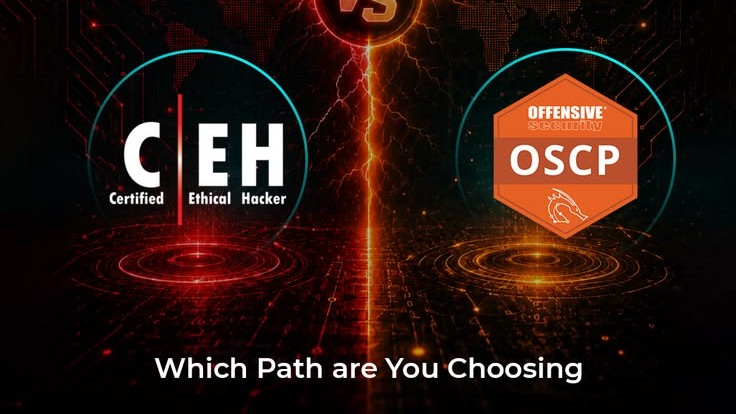
CEH vs OSCP: Complete Guide

Two certifications dominate every Nigerian ethical hacking conversation. Furthermore, both the CEH and OSCP are globally respected credentials.

Lagos Data School helps Nigerian professionals clearly choose the right certification. Therefore, this guide compares both across every factor that matters.

Also, Nigerian salary data and employer preferences are included throughout. By the end, you will know exactly which certification to pursue first.


What Is the CEH (Certified Ethical Hacker)?

The CEH is offered by EC-Council, one of the world’s largest cybersecurity bodies. Furthermore, visit EC-Council for full details and to book the exam. It covers all five phases of ethical hacking across twenty hacking domains. Also, the exam consists of 125 multiple-choice questions in four hours.

This may contain: the ceh logo is red and white with black letters that read certified, medical hacker

Consequently, the CEH is the most widely recognised ethical hacking cert in Nigeria. In short, CEH is the career entry credential that most Nigerian employers recognise first.


CEH Requirements at a Glance

Meeting the CEH requirements is achievable for most Nigerian professionals. Furthermore, two pathways exist depending on your current experience level.


  • Training pathway: Attend EC-Council authorised training then sit the exam.
  • Experience pathway: Two years of security experience qualifies you directly.
  • Exam format: 125 MCQ questions completed in four hours online.
  • Pass mark: 70% required — exact score varies by question bank.
  • Renewal needed: Every three years with 120 ECE credits required.


Also, the exam can be taken online from any location in Nigeria. Consequently, Nigerian professionals in all cities can access the CEH remotely.

CEH Cost for Nigerian Professionals

The CEH exam costs $950 to $1,200 USD depending on the registration route. Furthermore, EC-Council training adds $500 to $2,000 to the total investment. Also, approved training centres in Lagos offer discounted bundles for Nigerians.

Consequently, budgeting ₦2,500,000 to ₦5,000,000 covers both training and the exam. Therefore, the CEH is a significant but worthwhile investment for Nigerian professionals.


What Is the OSCP (Offensive Security Certified Professional)?

The OSCP is the most respected hands-on penetration testing certification globally. Furthermore, it is offered by Offensive Security at offensive-security.com. It requires completing a 24-hour practical hacking exam with no multiple choice. Also, candidates must compromise a specific number of machines to pass.

Consequently, passing the OSCP proves real, practical hacking skill above all else. In short, the OSCP is the certification that Nigerian employers trust most for senior roles.


OSCP Requirements at a Glance

The OSCP requires committed preparation before any registration attempt. Furthermore, prior experience with Linux and basic networking is strongly required.


  • Prior knowledge: Linux proficiency and networking fundamentals are mandatory.
  • Course required: PWK (Penetration Testing with Kali Linux) course is bundled.
  • Lab access: 90-day lab access is included with the standard package.
  • Exam format: 24-hour practical exam — no multiple-choice questions.
  • Pass requirement: Specific machine count plus a professional report submitted.


Also, the PWK course materials are included in every OSCP registration package. Consequently, Nigerian professionals receive structured learning alongside lab practice.


OSCP Cost for Nigerian Professionals

The OSCP bundle costs $1,499 USD for 90 days of lab access. Furthermore, extended lab access packages cost $1,649 for 120 days. Also, the exam attempt is included in the initial registration fee.

Consequently, the OSCP costs between ₦2,400,000 and ₦2,700,000 at current exchange rates. Therefore, the OSCP is more expensive per exam but includes more learning value.


CEH vs OSCP: A Complete Side-by-Side Comparison

Factor CEH OSCP
Offered by EC-Council Offensive Security
Level Intermediate Advanced
Exam format 125 MCQ in 4 hours 24-hour practical exam
Skills tested Broad theoretical and applied Hands-on exploitation only
Prior experience 2 years or approved training Linux + networking basics needed
Course included Optional paid training PWK course bundled in fee
Lab access Not included in base fee 90–120 days included
Cost (USD) $950–$1,200 exam only $1,499–$1,649 full bundle
Renewal Every 3 years — 120 ECE credits Does not expire
Nigerian recognition Widely recognised by all employers Highly valued for senior roles
Salary impact ₦1.5m–₦4m increase ₩4m–₩12m increase


Which Certification Should Nigerian Professionals Pursue First?


Choose the CEH If You Are…

A beginner or intermediate professional entering ethical hacking. Furthermore, the CEH suits you if you want broad theoretical coverage. Also, Nigerian employers in banking and government recognise the CEH widely.

Consequently, the CEH gives you faster entry into Nigerian cybersecurity roles. Therefore, start with the CEH if speed to employment is your primary goal.


Choose the OSCP If You Are…

An experienced ethical hacker with at least one to two years of practice. Furthermore, the OSCP suits you if you want to prove real exploitation skills. Also, Nigerian security consultancies and international firms prize the OSCP highly.

Consequently, OSCP holders in Nigeria consistently command the highest salaries. Therefore, pursue the OSCP after the CEH for the strongest possible combination.


The Ideal Nigerian Certification Path

Many top Nigerian ethical hackers hold both the CEH and the OSCP. Furthermore, the CEH builds your theoretical foundation across all twenty domains. Also, the OSCP proves your hands-on skill with a rigorous practical exam.

Consequently, holding both makes your CV extremely competitive in Nigeria. Therefore, plan to complete the CEH in year one and the OSCP in year two.


What Nigerian Employers Say About CEH vs OSCP

Nigerian employer preferences differ by sector and role level. Furthermore, understanding these preferences helps you choose strategically.


  • Banking sector: CEH is preferred for internal security team roles.
  • Consulting firms: OSCP holders win the most penetration testing contracts.
  • Fintech companies: Both certs are equally welcomed for product security roles.
  • Government agencies: CEH is the most frequently specified in Nigerian tenders.
  • International clients: OSCP is the most trusted credential for remote consulting.


In short, the CEH opens more doors initially across Nigerian industries. Consequently, the OSCP elevates your career ceiling to its highest possible level.


CEH vs OSCP Salary Data for Nigerian Professionals

Certification Role Level Annual Salary (Nigeria)
No certification Junior analyst ₦2,000,000 – ₦4,000,000
CEH only Mid-level ethical hacker ₩4,500,000 – ₩8,000,000
OSCP only Senior pen tester ₩8,000,000 – ₩15,000,000
CEH + OSCP Lead consultant ₩14,000,000 – ₩25,000,000
CEH + OSCP + 10 yrs CISO / Security Head ₩25,000,000 – ₩50,000,000+


How to Prepare for the CEH in Nigeria

Structured preparation is essential for the CEH exam in Nigeria. Furthermore, the exam covers 20 domains — breadth of knowledge is tested.


  • Study the courseware: EC-Council official materials cover all 20 domains.
  • Practice MCQs daily: Repetition across question banks builds exam confidence.
  • Use Boson practice: Boson CEH practice exams mirror the real question style.
  • Revise OWASP Top 10: Web vulnerabilities appear frequently in CEH questions.


Also, Lagos Data School offers structured CEH preparation in every cohort. Consequently, students receive guided study, mock exams, and exam strategy coaching.


How to Prepare for the OSCP in Nigeria

OSCP preparation demands daily hands-on practice over several months. Furthermore, TryHackMe and Hack The Box build the skills the exam tests.


  • TryHackMe first: Complete the Jr Penetration Tester learning path fully.
  • Hack The Box machines: Practise on easy and medium retired Linux machines.
  • Buffer overflow study: Buffer overflow exploitation appears in the OSCP exam.
  • Report writing practice: Write a professional report for every machine compromised.


In short, OSCP preparation is a full-time commitment of three to six months. Consequently, Nigerian professionals who commit fully pass on their first attempt.


Free Resource: TryHackMe OSCP Preparation Path

Lagos Data School recommends TryHackMe for both CEH and OSCP preparation. Furthermore, the Jr Penetration Tester path directly mirrors OSCP exam content.

Also, the CEH prep rooms cover all twenty ethical hacking domains for free. Consequently, Nigerian professionals can prepare for both exams at zero cost.


How Lagos Data School Prepares You for CEH and OSCP

Lagos Data School delivers live CEH preparation training for Nigerian professionals. Students complete mock exams, domain walkthroughs, and exam strategy sessions.

Furthermore, OSCP lab methodology is introduced in the advanced cybersecurity module. Consequently, graduates pass their chosen exam with real confidence and readiness.

Visit the Lagos Data School training page to enrol.


Frequently Asked Questions

Q1: Is the CEH harder than Security+?

Yes. The CEH covers more depth across ethical hacking domains than Security+. Furthermore, CEH questions test application knowledge rather than just definitions.

Also, Security+ is a better first certification before attempting the CEH. Therefore, pursue Security+ first and then the CEH for the strongest progression.


Q2: How long does the OSCP take to complete in Nigeria?

Most Nigerian professionals complete the OSCP preparation in three to six months. Furthermore, those with prior CTF experience may finish faster than average.

Also, the 24-hour exam can be scheduled any day directly through Offensive Security. Therefore, preparation time depends far more on daily practice than prior knowledge.


Q3: Can I take the OSCP exam from Nigeria?

Yes. The OSCP practical exam is taken remotely via a proctored VPN connection. Furthermore, a stable internet connection is the main technical requirement.

Also, Nigerian professionals in Lagos, Abuja, and Port Harcourt pass it regularly. Consequently, location in Nigeria is never a barrier to the OSCP certification.


Q4: Which certification is better for freelance ethical hacking in Nigeria?

The OSCP commands higher rates in freelance and consulting engagements. Furthermore, international clients specifically ask for OSCP on security contracts.

Also, bug bounty platforms reward OSCP holders with private programme invitations. Therefore, the OSCP is the better long-term investment for freelance Nigerians.


Q5: Does the CEH cover the same content as the OSCP?

Both cover ethical hacking but from very different angles and depths. Furthermore, the CEH is broad and theoretical across twenty domains.

Also, the OSCP is narrow and deeply practical — you must hack your way through. Therefore, they complement each other rather than compete.


Choose Your Path and Build Your Career with Lagos Data School

Both the CEH and OSCP are valuable, respected credentials in Nigeria. Furthermore, the right choice depends on your experience, goals, and timeline.

Lagos Data School prepares you for either exam with live training and expert guidance.

Visit Lagos Data School and start your certification journey today.
What Is Ethical Hacking: Complete Guide

What Is Ethical Hacking? A Plain Guide for Nigerian Beginners

Cybercrime is rising fast across Nigeria every year. Furthermore, Nigerian banks and fintechs lose billions of naira annually. Lagos Data School trains Nigerians to fight back with ethical hacking skills.

Story pin image

Therefore, this guide explains ethical hacking from the very beginning. Also, it covers careers, tools, certifications, and Nigerian salary data. By the end, you will understand this field clearly and completely.


What Is Ethical Hacking?

Ethical hacking is the authorised practice of attacking computer systems. Furthermore, the goal is to find security gaps before criminals do. Ethical hackers use the same tools as malicious hackers.

However, they always have written permission from the system owner. Also, they report every vulnerability they discover to the organisation. In short, ethical hacking is legal, planned, and purpose-driven security testing.


Why the Word ‘Ethical’ Matters

The word ‘ethical’ separates this practice from criminal hacking. Furthermore, ethical hackers follow a strict professional code. Organizations hire them to improve security, not to cause harm.

Consequently, the field is both lucrative and completely legal in Nigeria. Therefore, ethical hacking is one of the safest tech careers to pursue.


Ethical Hacking vs Malicious Hacking: The Key Differences

Factor Ethical Hacking Malicious Hacking
Permission Always written and formal None — completely unauthorised
Intent Find and fix vulnerabilities Steal data or cause damage
Reporting Full report given to the owner Hidden — damage is concealed
Legal status Legal with written permission Criminal offence in Nigeria
Outcome Stronger, more secure systems Financial and reputational loss
Nigerian law Protected under written agreement Prosecuted under Cybercrimes Act 2015


The Three Types of Hackers

Hackers are classified by their intent and authorisation level. Furthermore, knowing these types helps you position your career.


White Hat Hackers

White hat hackers are ethical professionals with full written authorisation. Furthermore, they are hired to test and improve organisational security. Every finding is documented and handed to the client team.

Consequently, Nigerian companies hire white hats to protect customer data. Therefore, white hat hacking is the most in-demand cybersecurity career here.


Black Hat Hackers

Black hat hackers attack systems without any permission at all. Furthermore, their goal is financial gain or deliberate disruption. They are responsible for most Nigerian cybercrime incidents.

Consequently, they face prosecution under the Cybercrimes Act 2015. In short, black hat hacking is illegal and causes enormous damage.


Grey Hat Hackers

Grey hat hackers operate between the two extremes above. Furthermore, they may probe systems without explicit permission. Often, they disclose findings publicly rather than exploiting them.

Consequently, their legal status remains unclear and sometimes contested. Therefore, Nigerian professionals must always operate strictly as white hats.


What Do Ethical Hackers Actually Do?

Ethical hackers run structured security assessments on digital systems. Furthermore, these assessments follow a well-defined five-phase methodology.

Every engagement is governed by a signed scope-of-work contract. Consequently, both the hacker and the client are protected legally.


The Five Phases of Ethical Hacking

Here are the five core phases every ethical hacker follows. Furthermore, each phase builds on the findings of the previous one.


  • Phase 1 — Reconnaissance: Legal information gathering about the target.
  • Scanning: Open ports and services are mapped carefully.
  • Access phase: Weaknesses are exploited in a controlled way.
  • Persistence testing: Depth of the breach is measured realistically.
  • Report phase: All findings are documented with fix recommendations.


Also, every phase produces documented evidence for the final report. Consequently, the client receives a clear, prioritised list of actions.


Nigerian Example: Ethical Hacking in a Lagos Bank

A Lagos tier-one bank hires an ethical hacker for a full review. Furthermore, written permission covers the mobile banking app specifically.

Reconnaissance reveals three exposed API endpoints in the system. Also, the hacker exploits one endpoint and accesses test accounts safely.

Next, a detailed report covers all three vulnerabilities found. Finally, the bank patches every issue within two weeks of receiving it. As a result, customer data stays protected from real attackers.


Why Ethical Hacking Is a High-Demand Career in Nigeria

Nigeria is Africa’s largest and fastest-growing digital economy. Furthermore, Nigerian banks process billions of naira in transactions daily. Government agencies store sensitive citizen data across digital platforms.

Also, every new fintech app creates a new potential security target. Consequently, ethical hackers are needed in every Nigerian industry. Therefore, demand for trained security professionals rises every single year.


Sectors That Hire Ethical Hackers in Nigeria

Several industries actively recruit ethical hackers across Nigeria. Furthermore, each sector faces unique cybersecurity challenges.


  • Banking: Fintechs and tier-one banks protect customer transactions daily.
  • Telecoms sector: MTN and Airtel guard critical subscriber network data.
  • Government bodies: NITDA and NIMC employ dedicated cybersecurity specialists.
  • Oil companies: Firms protect operational technology and SCADA systems.
  • Security consultancies: Lagos firms hire hackers for client penetration projects.


In short, cybersecurity roles exist across every major Nigerian industry. Consequently, a certified ethical hacker is employable in multiple sectors simultaneously.


Ethical Hacking Salaries in Nigeria

Role Experience Level Annual Salary (Nigeria)
Junior Ethical Hacker 0–2 years ₦3,500,000 – ₦6,000,000
Mid-Level Ethical Hacker 2–5 years ₦6,000,000 – ₦11,000,000
Senior Ethical Hacker 5–8 years ₦11,000,000 – ₦18,000,000
Lead Penetration Tester 8–12 years ₦18,000,000 – ₦28,000,000
CISO / Security Director 12+ years ₦28,000,000 – ₦50,000,000+


Key Technical Skills Nigerian Ethical Hackers Need

Technical skills form the foundation of every ethical hacking career. Furthermore, each skill builds on the previous one logically.


  • Networking knowledge: TCP/IP, DNS, and HTTP must be understood deeply.
  • Linux proficiency: Kali Linux runs most professional hacking tools.
  • Scripting basics: Python and Bash automate reconnaissance tasks efficiently.
  • Web app security: OWASP Top 10 is tested on nearly every engagement.
  • Scanning tools: Nmap, Wireshark, and Metasploit are daily essentials.


Also, non-technical skills like report writing and communication matter greatly. Consequently, Nigerian ethical hackers who communicate well get promoted faster.


Top Ethical Hacking Tools Nigerian Professionals Use

Tool Purpose Cost
Kali Linux Full ethical hacking OS with 600+ tools Free
Nmap Network scanning and port discovery Free
Metasploit Vulnerability exploitation framework Free + Paid
Wireshark Network packet capture and analysis Free
Burp Suite Web application security testing Free + Paid
Nikto Web server vulnerability scanner Free
John the Ripper Password cracking and strength testing Free


Legal Framework: Ethical Hacking in Nigeria

Ethical hacking must always be authorised in writing first. Furthermore, the Cybercrimes Act 2015 governs all computer activities.

Unauthorised access to any Nigerian system is a criminal offence. Also, a signed scope-of-work agreement protects both the hacker and client. Consequently, Nigerian ethical hackers must always secure written permission. Therefore, never test any system without a formal legal agreement.


What the Nigerian Cybercrimes Act 2015 Covers

The Act creates clear boundaries for Nigerian cybersecurity professionals. Furthermore, it defines specific offences and penalties for each.


  • Section 6: Unauthorised access carries a three-year prison term.
  • Section 8 covers: Intercepting electronic communications is criminal.
  • Identity theft: Section 14 makes electronic identity theft prosecutable.
  • Section 22 targets: Cyberstalking carries significant financial penalties.


In short, always work within a written, legally binding agreement. Consequently, legal compliance protects your career and your client’s business.


Top Ethical Hacking Certifications for Nigerian Professionals

Certification Offered By Level Cost (USD)
CEH EC-Council Intermediate $950–$1,200
CompTIA Security+ CompTIA Beginner $370
OSCP Offensive Security Advanced $1,499
eJPT eLearnSecurity Beginner $200
CompTIA PenTest+ CompTIA Intermediate $370


Three Common Myths About Ethical Hacking in Nigeria


Myth 1: You Must Be a Programmer First

Many Nigerian beginners think coding is mandatory from day one. However, networking and Linux skills matter more at the beginner level. Scripting is learned gradually as your career naturally advances. Therefore, start with networking and Linux — not programming courses.


Myth 2: Only Young People Can Learn Hacking

Career changers of all ages succeed in Nigerian cybersecurity roles. Furthermore, many professionals enter this field in their 30s and 40s. Analytical thinking and patience matter far more than age alone. Consequently, age is never a barrier to starting this career path.


Myth 3: A Computer Science Degree Is Required

No degree is required for ethical hacking roles in Nigeria. Furthermore, certifications and practical lab skills impress employers far more.

Many top Nigerian ethical hackers come from non-technical backgrounds. Therefore, certifications and a strong portfolio open Nigerian career doors faster.


Free Resource: OWASP Top 10

Lagos Data School recommends the OWASP Top 10 as your free first reference. Furthermore, it lists the ten most critical web application security risks. Every ethical hacker in Nigeria must understand these vulnerabilities deeply. Also, it is updated regularly to reflect the latest attack trends.


How Lagos Data School Trains Nigerian Ethical Hackers

Lagos Data School delivers live ethical hacking training across Nigeria. Students practise on real lab environments using Kali Linux and Metasploit.

Furthermore, every session uses Nigerian cybersecurity case studies specifically. Consequently, graduates are ready for real security assessments from day one.

Visit the Lagos Data School training page to enrol today.


Frequently Asked Questions

Q1: Is ethical hacking legal in Nigeria?

Yes. Ethical hacking is completely legal with written permission. Furthermore, the Cybercrimes Act 2015 protects authorised security testing.

Also, a signed scope-of-work protects both parties legally. Therefore, always secure written authorisation before any testing begins.


Q2: How long does it take to start in Nigeria?

Most Nigerian professionals reach entry level within six to twelve months. Furthermore, dedicated lab practice speeds up this timeline significantly.

Also, structured training programmes shorten the learning curve greatly. Therefore, Lagos Data School’s course is the fastest Nigerian entry path.


Q3: Can I study ethical hacking online from Nigeria?

Yes. Many top courses are fully accessible online. Furthermore, TryHackMe offers free browser-based hacking labs.  Also, Lagos Data School delivers live online sessions for Nigerian professionals. Consequently, your location in Nigeria is never a barrier here.


Q4: Which certification should I get first?

Start with CompTIA Security+ or eJPT for a beginner-friendly entry. Furthermore, both are affordable and recognised by Nigerian employers. Also, the CEH is a strong intermediate step after your first cert. Therefore, plan a certification path of at least two to three credentials.


Q5: Do Nigerian banks hire ethical hackers?

Yes. Most tier-one Nigerian banks have dedicated in-house security teams. Furthermore, many outsource penetration testing to certified consultants. Also, Lagos fintech companies hire ethical hackers for product security. Consequently, banking and fintech are the top two sectors for these jobs.


Start Your Ethical Hacking Journey with Lagos Data School

Ethical hacking is one of the most exciting careers in Nigerian tech today. Furthermore, demand is growing, and salaries are rising every single year. Lagos Data School gives you live training and real labs to build these skills.

Visit Lagos Data School and enrol in the cybersecurity course today.

How to Become an Ethical Hacker in Nigeria: Step-by-Step Roadmap

How to Become an Ethical Hacker in Nigeria: The Full Roadmap

Ethical hacking is one of Nigeria’s fastest-growing tech careers. Furthermore, Nigerian banks, fintechs, and telecoms are actively recruiting. Lagos Data School trains Nigerian professionals to enter this field confidently.

This may contain: the title for the book, ethical hacking guide

Therefore, this guide gives you the complete step-by-step action plan. Also, it covers skills, certifications, tools, and real salary data. By the end, you will have a clear plan to follow from tomorrow.


Why Ethical Hacking Is One of Nigeria’s Best Career Choices

Cybercrime cost Nigeria over ₦650 billion in losses in 2023 alone. Furthermore, this number grows with every new digital service launched.

Nigeria’s digital economy expands rapidly across all industries. Also, every new app and government portal needs proper security testing.

Consequently, ethical hackers are in urgent demand across all sectors. Therefore, this career offers job security, strong pay, and global opportunity.


Quick Facts About Ethical Hacking Jobs in Nigeria

Several facts highlight why this career is worth pursuing right now. Furthermore, the numbers tell a compelling story for Nigerian professionals.


  • Demand is growing: Cybersecurity job posts in Lagos grew 40% in 2024.
  • Salaries are strong: Entry-level hackers earn ₦3.5m–₦6m yearly.
  • Certifications go global: CEH and OSCP are recognised worldwide.
  • Remote work is common: Many Nigerians work for international clients online.
  • Sectors are diverse: Banking, oil, telecoms, and government all recruit.


In short, this career path offers both local and international opportunities. Consequently, Nigerian ethical hackers often earn in foreign currency remotely.


The Step-by-Step Roadmap: Eight Clear Steps


Step 1: Build a Strong Networking Foundation

Networking is the backbone of all ethical hacking knowledge. Furthermore, you must understand how data travels across networks.

Learn TCP/IP, DNS, HTTP, HTTPS, and firewall basics thoroughly. Also, the CompTIA Network+ certification validates these core concepts well.

Consequently, you will understand exactly what you attack and defend. Therefore, start with networking before touching any hacking tool at all.


Step 2: Learn Linux, Especially Kali Linux

Most ethical hacking tools run exclusively on Linux systems. Furthermore, Kali Linux is the standard hacker operating system globally. It ships pre-loaded with over 600 security testing tools. Also, download it free at kali.org and install it today.

Consequently, Nigerian beginners must master the Linux command line confidently. Therefore, spend at least four weeks practising Linux commands every day.


Step 3: Get Your First Security Certification

Start with an entry-level certification to validate your foundation knowledge.

Furthermore, CompTIA Security+ is the most recognised beginner cert in Nigeria. Additionally, eJPT (eLearnSecurity Junior Penetration Tester) is practical and cheap. Also, both exams are taken fully online from anywhere in Nigeria.

Consequently, your first certification proves readiness to Nigerian employers. Therefore, aim to complete your first certification within three months.


Step 4: Learn Web Application Security

Web apps are the most common ethical hacking target in Nigeria. Furthermore, the OWASP Top 10 covers the most critical web vulnerabilities. Also, visit OWASP.org for free web security resources today.

Consequently, SQL injection, XSS, and CSRF knowledge becomes essential. In addition, Burp Suite Community Edition is the free tool for web testing. Therefore, dedicate at least one month to web application security practice.


Step 5: Build a Home Lab and Practise Every Day

Theory without daily practice never produces skilled ethical hackers. Furthermore, a home lab lets you attack systems safely and legally. Also, TryHackMe offers free browser-based labs for Nigerian beginners.

Consequently, you build real hands-on skills without buying expensive equipment. In addition, VirtualBox with vulnerable machines creates a local practice environment. Therefore, practise for at least one hour every single day without exception.


Step 6: Pursue the CEH Certification

The CEH is the most recognised mid-level credential in Nigeria. Furthermore, it is offered by EC-Council at eccouncil.org. Also, it covers all five ethical hacking phases in structured depth.

Consequently, CEH holders are preferred candidates for Nigerian security jobs. In addition, the exam covers 125 questions across twenty hacking domains. Therefore, plan three to six months of dedicated preparation before exam day.


Step 7: Build Your Security Portfolio

A portfolio proves your skills far beyond any single certification. Furthermore, document every lab exercise and CTF challenge you complete. Also, write short pen test reports for each completed exercise you do.

Consequently, Nigerian employers see real, verifiable proof of your skills. In addition, a GitHub profile hosting your scripts strengthens your application. Therefore, treat every lab session as a real client engagement always.


Step 8: Apply for Nigerian Cybersecurity Roles

Start applying after completing your first two certifications confidently. Furthermore, target junior penetration tester and security analyst roles first.

Also, Nigerian cybersecurity firms like Sysops offer entry-level opportunities. Consequently, your first role builds experience for senior positions later.

In addition, LinkedIn and Jobberman list Nigerian cybersecurity vacancies daily. Therefore, apply consistently and follow up on every application you submit.


The Full Eight-Step Roadmap at a Glance

Step Action Timeline
1 Learn networking: TCP/IP, DNS, HTTP, firewalls Month 1–2
2 Install Kali Linux and practise the Linux command line Month 2–3
3 Get CompTIA Security+ or eJPT certification Month 3–5
4 Study OWASP Top 10 and web application security Month 4–6
5 Build a home lab — use TryHackMe daily Month 5–8
6 Pursue the CEH certification Month 8–12
7 Build a portfolio with lab write-ups and pentest reports Ongoing
8 Apply for junior security analyst or penetration tester roles Month 12+


Essential Tools Every Nigerian Ethical Hacker Must Know

Tools are the daily weapons of every professional ethical hacker. Furthermore, mastering these seven tools builds a strong technical foundation.


  • Kali Linux: The hacker OS — pre-loaded with 600+ tools.
  • Nmap scans: Discovers open ports and running network services.
  • Metasploit exploits: Tests and exploits known system vulnerabilities.
  • Burp Suite tests: Finds OWASP Top 10 flaws in web apps.
  • Wireshark captures: Analyses live network traffic in real time.
  • Aircrack-ng tests: Audits wireless network security and WPA strength.
  • Hydra brute-forces: Tests login page password policy robustness.


Also, each tool has a free version available for Nigerian students. Consequently, you can build full tool proficiency at zero cost initially.


Certification Path for Nigerian Ethical Hackers

Stage Certification Cost (USD) Study Time
Beginner CompTIA Security+ $370 2–3 months
Beginner eJPT $200 1–2 months
Intermediate CEH $950–1,200 3–6 months
Intermediate CompTIA PenTest+ $370 2–4 months
Advanced OSCP $1,499 6–12 months
Advanced GPEN (GIAC) $2,000+ 6–12 months


Nigerian Ethical Hacking Communities Worth Joining

Communities accelerate learning faster than solo study ever does. Furthermore, Nigerian cybersecurity groups share job leads and resources regularly.


  • CyberSafe Foundation: A Nigerian NGO promoting cybersecurity awareness nationally.
  • NCS membership: Nigeria Computer Society connects ICT practitioners professionally.
  • ISACA Nigeria: Links security and IT audit professionals across Nigeria.
  • TryHackMe Discord: Global community where Nigerians share hacking tips freely.


In short, joining one community multiplies your learning speed significantly. Consequently, you gain mentors, job leads, and practice partners quickly.


Free Resource: TryHackMe Learning Paths

Lagos Data School recommends TryHackMe as the best free platform for Nigerian beginners. Furthermore, the Pre-Security and Jr Penetration Tester paths are completely free. Every lab runs in a browser — no downloads or local setup required. Also, Nigerian professionals in any city can practise ethical hacking today.


How Lagos Data School Prepares Nigerian Ethical Hackers

Lagos Data School delivers live cybersecurity training across Nigeria. Students practise in real lab environments using Kali Linux and Metasploit.

Furthermore, CEH exam preparation is embedded throughout every module. Consequently, graduates leave with practical skills and full certification readiness.

Visit the Lagos Data School training page to enrol.


Frequently Asked Questions

Q1: Do I need a degree to start in Nigeria?

No. A degree is not required for ethical hacking roles. Furthermore, certifications and practical skills matter far more to employers. Also, many top Nigerian ethical hackers started without any degree at all. Therefore, focus on certifications and lab practice — not formal education.


Q2: How much does ethical hacking training cost in Nigeria?

Training costs range from ₦50,000 to ₦500,000 depending on the programme. Furthermore, Lagos Data School offers structured courses at competitive rates. Also, free platforms like TryHackMe reduce overall self-study costs significantly. Therefore, a combination of paid training and free labs is the smartest investment.


Q3: Can I work as a freelance ethical hacker in Nigeria?

Yes. Many Nigerian ethical hackers work as independent security consultants. Furthermore, bug bounty programmes on HackerOne pay in USD for valid discoveries. Also, freelance engagements typically pay more per project than full-time roles. Consequently, a freelance practice is a smart long-term Nigerian career strategy.


Q4: What is the best first step for a complete beginner?

Install Kali Linux and complete TryHackMe’s free Pre-Security path first. Furthermore, read the CompTIA Security+ study guide at the same time.

Also, join Lagos Data School’s cybersecurity cohort for live structured guidance. Therefore, combining free labs with live training is the fastest Nigerian path.


Q5: Is the OSCP worth pursuing for Nigerians?

Yes. The OSCP is the most respected hands-on hacking certification globally. Furthermore, it demonstrates real practical skill rather than just book knowledge. Also, OSCP holders in Nigeria command the highest salaries in the security field. Therefore, target it after gaining at least two to three years of experience.


Build Your Career with Lagos Data School

Ethical hacking offers Nigeria’s clearest path into premium tech careers. Furthermore, demand, salaries, and remote work options all grow every year. Lagos Data School gives you training, labs, and certification prep to succeed.

Visit Lagos Data School and enrol in the cybersecurity course today.

Penetration Testing vs Ethical Hacking: Complete 2026 Guide

Penetration Testing vs Ethical Hacking: What Is the Real Difference?

Many Nigerian professionals use these two terms interchangeably. However, they are not the same thing at all. Lagos Data School explains both terms clearly and completely here. Therefore, this guide covers definitions, differences, types, and careers.

Also, Nigerian examples and salary data are included throughout. By the end, you will use both terms correctly in any workplace.


Defining Ethical Hacking

Ethical hacking is the broad practice of attacking systems with permission. Furthermore, it covers all forms of authorised offensive security work.

Story pin image

Also, it includes penetration testing, vulnerability assessments, and red teaming. Consequently, ethical hacking is the umbrella term for all legal security testing. In short, if you have written permission to test a system, that is ethical hacking.


Defining Penetration Testing

Penetration testing is one specific type of ethical hacking engagement. Furthermore, it simulates a real cyberattack on a defined target system.

Story pin image

Also, the goal is to see how far an attacker could realistically penetrate. Consequently, a penetration test always produces a detailed vulnerability report. In short, pen testing is ethical hacking with a narrow, well-defined scope.


The Core Difference: Scope and Structure

Ethical hacking is broad and may include many different security activities. However, penetration testing is narrow and follows a specific methodology. Furthermore, pen tests have a defined start date, end date, and agreed scope.

Also, ethical hacking can be an ongoing, open-ended security team role. Consequently, a security professional may do ethical hacking every single day. Therefore, penetration testing is one tool within the ethical hacking toolkit.


Penetration Testing vs Ethical Hacking: Side-by-Side

Factor Ethical Hacking Penetration Testing
Scope Broad — covers all security testing areas Narrow — specific target defined
Duration Ongoing role or long-term contract Fixed time box — days to weeks
Methodology Flexible and exploratory Structured and formally documented
Goal Improve overall security posture broadly Find and exploit specific vulnerabilities
Report May include many types of outputs Always produces a formal pen test report
Nigerian use In-house teams at Nigerian banks Hired firm tests a specific app
Common certs CEH, Security+ OSCP, GPEN, CompTIA PenTest+


What Is a Vulnerability Assessment?

A vulnerability assessment is a third term that causes confusion in Nigeria. Furthermore, it is different from both ethical hacking and pen testing.

Also, it identifies weaknesses but does not attempt to exploit any of them. Consequently, it tells you what vulnerabilities exist — not how far they reach. Therefore, a pen test always goes deeper than a vulnerability assessment alone.


The Three Levels of Nigerian Security Testing

Level Name What It Does Nigerian Example
1 Vulnerability Assessment Scans and flags weaknesses only Bank runs a quarterly server scan
2 Penetration Testing Exploits weaknesses to test real impact Firm tests the mobile banking app
3 Red Team Exercise Full simulated attack on the whole org Military-style attack drill on a telecom


Types of Penetration Testing Used in Nigeria


Network Penetration Testing

Network pen testing attacks internal and external network infrastructure. Furthermore, it finds misconfigured firewalls and weak protocols. Nigerian banks use this to protect core banking servers and switches.

Also, vulnerabilities in routers and VPNs are found and reported. Consequently, the entire network perimeter becomes stronger after each test.


Web Application Penetration Testing

Web app pen testing focuses on websites, APIs, and web portals. Furthermore, OWASP Top 10 vulnerabilities are tested on every engagement. Nigerian fintech apps and e-commerce platforms are common targets here.

Also, SQL injection, XSS, and broken authentication flaws are identified. Consequently, web app security improves significantly after each pen test.


Mobile Application Penetration Testing

Mobile pen testing targets Android and iOS applications directly. Furthermore, it checks data storage, API calls, and authentication. Nigerian banking apps are tested this way before every major release.

Also, insecure data storage and weak encryption are commonly found. Consequently, mobile security flaws are caught before customers are affected.


Social Engineering Testing

Social engineering tests the human element of organisational security. Furthermore, phishing emails and phone scams are simulated on real staff. Many Nigerian cybersecurity incidents start with a phishing attack first.

Also, training staff to spot phishing is as important as patching software. Consequently, human-layer security improves significantly after social testing.


Physical Penetration Testing

Physical pen testing tests physical access controls and security measures. Furthermore, testers attempt to enter server rooms without proper authorisation. Nigerian data centres use this test to find physical security weaknesses.

Also, tailgating attacks and badge cloning are simulated during these tests. Consequently, physical security gaps are identified and corrected quickly.


The Five-Phase Penetration Testing Methodology

Professional pen testing follows a structured methodology on every engagement. Furthermore, this protects both the tester and client throughout.


Phase 1: Pre-Engagement

Scope, rules of engagement, and legal agreements are defined here. Furthermore, start and end dates are agreed by all parties involved. Also, specific systems that can be tested are listed clearly in writing. Consequently, both the tester and the client are legally protected.


Phase 2: Reconnaissance

The tester gathers information using open-source intelligence tools. Furthermore, Maltego and Shodan are used for passive information gathering. Active scanning only begins after the pre-engagement agreement is signed.

Also, the tester builds a detailed picture of the target environment. Consequently, the attack phase is informed by solid prior intelligence.


Phase 3: Scanning and Enumeration

Nmap discovers open ports and identifies all running services. Furthermore, service versions are matched against known vulnerability databases.

Also, web directories and exposed login pages are enumerated carefully. Consequently, a prioritised list of attack vectors is compiled.


Phase 4: Exploitation

Identified vulnerabilities are exploited in a fully controlled manner. Furthermore, Metasploit and manual techniques are both commonly used.

Also, every successful exploit is documented with clear screenshots. Consequently, the evidence package becomes the basis for the final report.


Phase 5: Post-Exploitation and Reporting

The tester assesses what data could have been accessed after the breach. Furthermore, privilege escalation and lateral movement are tested here.

Also, a detailed report covering every finding is written and delivered. Consequently, the Nigerian client receives a clear, prioritised fix list.


What a Professional Pen Test Report Includes

Section Content
Executive Summary High-level overview for Nigerian management and board
Scope and Methodology Systems tested, engagement dates, and approach used
Findings Summary Count of Critical, High, Medium, and Low findings
Detailed Findings Each vulnerability with CVSS score and exploit evidence
Remediation Guidance Specific fix recommendations ordered by risk priority
Re-test Schedule Recommended timeline for verifying that fixes work


Career Paths: Ethical Hacker vs Penetration Tester in Nigeria

Area Ethical Hacker Career Penetration Tester Career
Work style Broad security role across many areas Specialist focused on testing only
Employment In-house team or broad consultancy Specialist firm or freelance
Key certs CEH, Security+, CISSP OSCP, GPEN, PenTest+
Nigerian salary ₦4m–₩18m per year ₩6m–₩28m per year
Best employers Banks, fintechs, telecoms Security firms, international clients


Which Nigerian Regulations Require Penetration Testing?

Nigerian regulators now require regular security testing across many industries. Furthermore, compliance is driving demand for pen testers rapidly.


  • CBN Framework: Requires regular security assessments for all Nigerian banks.
  • NDPR regulation: NITDA mandates organisations test their data systems regularly.
  • NCC requirements: Telecoms must conduct security testing under NCC guidelines.
  • Pension regulator: PenCom requires cybersecurity audits for pension fund administrators.


In short, regulatory compliance is the biggest driver of pen testing demand. Consequently, Nigerian pen testers with OSCP or CEH are actively sought after.


Free Resource: PTES Standard

Lagos Data School recommends the PTES Standard as a free methodology reference. Furthermore, it defines every phase of a professional penetration test.

Also, it is used as the baseline methodology by Nigerian security consultancies. Consequently, understanding PTES makes every Nigerian pen tester more credible.


How Lagos Data School Teaches Pen Testing and Ethical Hacking

Lagos Data School covers both disciplines in its live cybersecurity course. Students practise web, network, and mobile pen testing in every session. Furthermore, the complete five-phase methodology is applied on live lab systems. Consequently, graduates write professional pen test reports from day one.

Visit the Lagos Data School training page to enrol.


Frequently Asked Questions

Q1: Is penetration testing in high demand in Nigeria?

Yes. It is one of the fastest-growing services in Nigerian cybersecurity. Furthermore, CBN and NITDA regulations now mandate regular bank pen tests.

Also, international firms operating in Nigeria require local security assessments. Consequently, OSCP or CEH-certified Nigerians are actively sought across sectors.


Q2: How much does a penetration test cost in Nigeria?

A basic web app pen test costs ₦500,000 to ₦2,000,000 in Nigeria. Furthermore, comprehensive network tests for large organisations cost more.

Also, price depends on scope, duration, and the consultant’s certification level. Therefore, certified Nigerian pen testers command premium rates from clients.


Q3: Can Nigerian freelancers do penetration testing remotely?

Yes. Freelance penetration testing is growing rapidly across Nigeria. Furthermore, Nigerian pen testers work for global clients through online platforms.

Also, bug bounty programmes pay Nigerians in USD for valid vulnerability discoveries. Consequently, freelance pen testing offers strong foreign exchange earning potential.


Q4: What is the OSCP and why does it matter for Nigerians?

The OSCP is Offensive Security Certified Professional — the most respected pen cert globally. Furthermore, it is offered by Offensive Security at offensive-security.com.

Also, passing requires completing a gruelling 24-hour hands-on hacking exam. Consequently, OSCP holders in Nigeria command the highest cybersecurity salaries here.


Q5: What is the difference between a red team and a pen test?

A pen test is scoped, structured, and delivered within a fixed time box. Furthermore, a red team exercise simulates a full, unrestricted adversary attack.

Also, red teams use deception, physical intrusion, and social engineering together. Consequently, red teaming is more expensive and more comprehensive than pen testing.


Master Pen Testing and Ethical Hacking with Lagos Data School

Both disciplines offer rewarding, well-paying careers in Nigerian tech. Furthermore, regulatory demand, growing threats, and rising salaries make this field exceptional.

Lagos Data School trains you with live labs, real methodology, and CEH preparation.

Visit Lagos Data School and enrol in the cybersecurity programme today.

Hi, How Can We Help You?
Welcome To
Lagos Data School

Artificial Intelligence (AI), Machine Learning and Robotics Programmes Are Now Available!!!

Enroll Now!

Thank You
100% secure website.