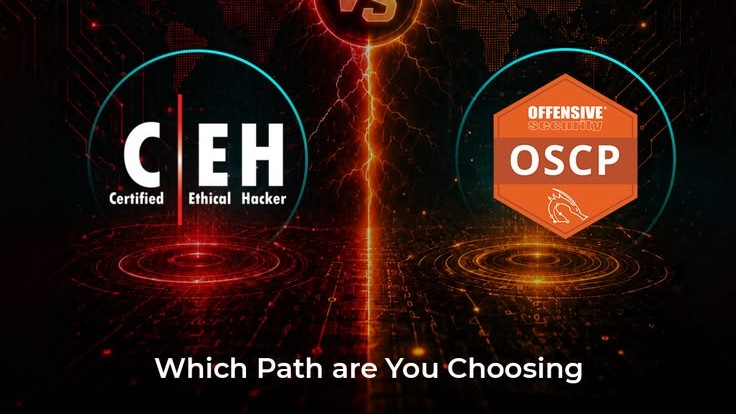
CEH vs OSCP: Complete Guide

Two certifications dominate every Nigerian ethical hacking conversation. Furthermore, both the CEH and OSCP are globally respected credentials.

Lagos Data School helps Nigerian professionals clearly choose the right certification. Therefore, this guide compares both across every factor that matters.

Also, Nigerian salary data and employer preferences are included throughout. By the end, you will know exactly which certification to pursue first.


What Is the CEH (Certified Ethical Hacker)?

The CEH is offered by EC-Council, one of the world’s largest cybersecurity bodies. Furthermore, visit EC-Council for full details and to book the exam. It covers all five phases of ethical hacking across twenty hacking domains. Also, the exam consists of 125 multiple-choice questions in four hours.

This may contain: the ceh logo is red and white with black letters that read certified, medical hacker

Consequently, the CEH is the most widely recognised ethical hacking cert in Nigeria. In short, CEH is the career entry credential that most Nigerian employers recognise first.


CEH Requirements at a Glance

Meeting the CEH requirements is achievable for most Nigerian professionals. Furthermore, two pathways exist depending on your current experience level.


  • Training pathway: Attend EC-Council authorised training then sit the exam.
  • Experience pathway: Two years of security experience qualifies you directly.
  • Exam format: 125 MCQ questions completed in four hours online.
  • Pass mark: 70% required — exact score varies by question bank.
  • Renewal needed: Every three years with 120 ECE credits required.


Also, the exam can be taken online from any location in Nigeria. Consequently, Nigerian professionals in all cities can access the CEH remotely.

CEH Cost for Nigerian Professionals

The CEH exam costs $950 to $1,200 USD depending on the registration route. Furthermore, EC-Council training adds $500 to $2,000 to the total investment. Also, approved training centres in Lagos offer discounted bundles for Nigerians.

Consequently, budgeting ₦2,500,000 to ₦5,000,000 covers both training and the exam. Therefore, the CEH is a significant but worthwhile investment for Nigerian professionals.


What Is the OSCP (Offensive Security Certified Professional)?

The OSCP is the most respected hands-on penetration testing certification globally. Furthermore, it is offered by Offensive Security at offensive-security.com. It requires completing a 24-hour practical hacking exam with no multiple choice. Also, candidates must compromise a specific number of machines to pass.

Consequently, passing the OSCP proves real, practical hacking skill above all else. In short, the OSCP is the certification that Nigerian employers trust most for senior roles.


OSCP Requirements at a Glance

The OSCP requires committed preparation before any registration attempt. Furthermore, prior experience with Linux and basic networking is strongly required.


  • Prior knowledge: Linux proficiency and networking fundamentals are mandatory.
  • Course required: PWK (Penetration Testing with Kali Linux) course is bundled.
  • Lab access: 90-day lab access is included with the standard package.
  • Exam format: 24-hour practical exam — no multiple-choice questions.
  • Pass requirement: Specific machine count plus a professional report submitted.


Also, the PWK course materials are included in every OSCP registration package. Consequently, Nigerian professionals receive structured learning alongside lab practice.


OSCP Cost for Nigerian Professionals

The OSCP bundle costs $1,499 USD for 90 days of lab access. Furthermore, extended lab access packages cost $1,649 for 120 days. Also, the exam attempt is included in the initial registration fee.

Consequently, the OSCP costs between ₦2,400,000 and ₦2,700,000 at current exchange rates. Therefore, the OSCP is more expensive per exam but includes more learning value.


CEH vs OSCP: A Complete Side-by-Side Comparison

Factor CEH OSCP
Offered by EC-Council Offensive Security
Level Intermediate Advanced
Exam format 125 MCQ in 4 hours 24-hour practical exam
Skills tested Broad theoretical and applied Hands-on exploitation only
Prior experience 2 years or approved training Linux + networking basics needed
Course included Optional paid training PWK course bundled in fee
Lab access Not included in base fee 90–120 days included
Cost (USD) $950–$1,200 exam only $1,499–$1,649 full bundle
Renewal Every 3 years — 120 ECE credits Does not expire
Nigerian recognition Widely recognised by all employers Highly valued for senior roles
Salary impact ₦1.5m–₦4m increase ₩4m–₩12m increase


Which Certification Should Nigerian Professionals Pursue First?


Choose the CEH If You Are…

A beginner or intermediate professional entering ethical hacking. Furthermore, the CEH suits you if you want broad theoretical coverage. Also, Nigerian employers in banking and government recognise the CEH widely.

Consequently, the CEH gives you faster entry into Nigerian cybersecurity roles. Therefore, start with the CEH if speed to employment is your primary goal.


Choose the OSCP If You Are…

An experienced ethical hacker with at least one to two years of practice. Furthermore, the OSCP suits you if you want to prove real exploitation skills. Also, Nigerian security consultancies and international firms prize the OSCP highly.

Consequently, OSCP holders in Nigeria consistently command the highest salaries. Therefore, pursue the OSCP after the CEH for the strongest possible combination.


The Ideal Nigerian Certification Path

Many top Nigerian ethical hackers hold both the CEH and the OSCP. Furthermore, the CEH builds your theoretical foundation across all twenty domains. Also, the OSCP proves your hands-on skill with a rigorous practical exam.

Consequently, holding both makes your CV extremely competitive in Nigeria. Therefore, plan to complete the CEH in year one and the OSCP in year two.


What Nigerian Employers Say About CEH vs OSCP

Nigerian employer preferences differ by sector and role level. Furthermore, understanding these preferences helps you choose strategically.


  • Banking sector: CEH is preferred for internal security team roles.
  • Consulting firms: OSCP holders win the most penetration testing contracts.
  • Fintech companies: Both certs are equally welcomed for product security roles.
  • Government agencies: CEH is the most frequently specified in Nigerian tenders.
  • International clients: OSCP is the most trusted credential for remote consulting.


In short, the CEH opens more doors initially across Nigerian industries. Consequently, the OSCP elevates your career ceiling to its highest possible level.


CEH vs OSCP Salary Data for Nigerian Professionals

Certification Role Level Annual Salary (Nigeria)
No certification Junior analyst ₦2,000,000 – ₦4,000,000
CEH only Mid-level ethical hacker ₩4,500,000 – ₩8,000,000
OSCP only Senior pen tester ₩8,000,000 – ₩15,000,000
CEH + OSCP Lead consultant ₩14,000,000 – ₩25,000,000
CEH + OSCP + 10 yrs CISO / Security Head ₩25,000,000 – ₩50,000,000+


How to Prepare for the CEH in Nigeria

Structured preparation is essential for the CEH exam in Nigeria. Furthermore, the exam covers 20 domains — breadth of knowledge is tested.


  • Study the courseware: EC-Council official materials cover all 20 domains.
  • Practice MCQs daily: Repetition across question banks builds exam confidence.
  • Use Boson practice: Boson CEH practice exams mirror the real question style.
  • Revise OWASP Top 10: Web vulnerabilities appear frequently in CEH questions.


Also, Lagos Data School offers structured CEH preparation in every cohort. Consequently, students receive guided study, mock exams, and exam strategy coaching.


How to Prepare for the OSCP in Nigeria

OSCP preparation demands daily hands-on practice over several months. Furthermore, TryHackMe and Hack The Box build the skills the exam tests.


  • TryHackMe first: Complete the Jr Penetration Tester learning path fully.
  • Hack The Box machines: Practise on easy and medium retired Linux machines.
  • Buffer overflow study: Buffer overflow exploitation appears in the OSCP exam.
  • Report writing practice: Write a professional report for every machine compromised.


In short, OSCP preparation is a full-time commitment of three to six months. Consequently, Nigerian professionals who commit fully pass on their first attempt.


Free Resource: TryHackMe OSCP Preparation Path

Lagos Data School recommends TryHackMe for both CEH and OSCP preparation. Furthermore, the Jr Penetration Tester path directly mirrors OSCP exam content.

Also, the CEH prep rooms cover all twenty ethical hacking domains for free. Consequently, Nigerian professionals can prepare for both exams at zero cost.


How Lagos Data School Prepares You for CEH and OSCP

Lagos Data School delivers live CEH preparation training for Nigerian professionals. Students complete mock exams, domain walkthroughs, and exam strategy sessions.

Furthermore, OSCP lab methodology is introduced in the advanced cybersecurity module. Consequently, graduates pass their chosen exam with real confidence and readiness.

Visit the Lagos Data School training page to enrol.


Frequently Asked Questions

Q1: Is the CEH harder than Security+?

Yes. The CEH covers more depth across ethical hacking domains than Security+. Furthermore, CEH questions test application knowledge rather than just definitions.

Also, Security+ is a better first certification before attempting the CEH. Therefore, pursue Security+ first and then the CEH for the strongest progression.


Q2: How long does the OSCP take to complete in Nigeria?

Most Nigerian professionals complete the OSCP preparation in three to six months. Furthermore, those with prior CTF experience may finish faster than average.

Also, the 24-hour exam can be scheduled any day directly through Offensive Security. Therefore, preparation time depends far more on daily practice than prior knowledge.


Q3: Can I take the OSCP exam from Nigeria?

Yes. The OSCP practical exam is taken remotely via a proctored VPN connection. Furthermore, a stable internet connection is the main technical requirement.

Also, Nigerian professionals in Lagos, Abuja, and Port Harcourt pass it regularly. Consequently, location in Nigeria is never a barrier to the OSCP certification.


Q4: Which certification is better for freelance ethical hacking in Nigeria?

The OSCP commands higher rates in freelance and consulting engagements. Furthermore, international clients specifically ask for OSCP on security contracts.

Also, bug bounty platforms reward OSCP holders with private programme invitations. Therefore, the OSCP is the better long-term investment for freelance Nigerians.


Q5: Does the CEH cover the same content as the OSCP?

Both cover ethical hacking but from very different angles and depths. Furthermore, the CEH is broad and theoretical across twenty domains.

Also, the OSCP is narrow and deeply practical — you must hack your way through. Therefore, they complement each other rather than compete.


Choose Your Path and Build Your Career with Lagos Data School

Both the CEH and OSCP are valuable, respected credentials in Nigeria. Furthermore, the right choice depends on your experience, goals, and timeline.

Lagos Data School prepares you for either exam with live training and expert guidance.

Visit Lagos Data School and start your certification journey today.
CEH vs CompTIA Security+ vs CISSP: Which Cybersecurity Certification Should You Get in Nigeria?

Introduction

Cybersecurity is one of the fastest-growing career fields in Nigeria. With the rapid digitization of banking, government services, telecoms, and e-commerce, the demand for qualified cybersecurity professionals across Lagos, Abuja, Port Harcourt, and beyond has never been higher. Whether you work for a fintech startup, a multinational corporation, or aspire to consult independently, the right certification can be the difference between landing a ₦400,000-a-month role and being overlooked entirely.

Three certifications consistently appear at the top of Nigerian job listings: the Certified Ethical Hacker (CEH), CompTIA Security+, and the Certified Information Systems Security Professional (CISSP). But which one is right for you? In this guide, we break down each certification’s requirements, costs in naira, career outcomes, and relevance to the Nigerian cybersecurity job market  so you can make an informed decision.

Overview: The Three Major Cybersecurity Certifications

1. CompTIA Security+

Issued by CompTIA, Security+ is a globally recognized, vendor-neutral entry-level cybersecurity certification. It validates baseline skills in network security, threat detection, risk management, and cryptography. It is widely accepted by both Nigerian and international employers and is often the first certification IT professionals pursue after foundational qualifications like CompTIA A+ or Network+.

Security+ is also DoD 8570-compliant, meaning it satisfies United States Department of Defense baseline requirements a critical advantage for anyone seeking roles in multinational firms, NGOs, or international organizations operating in Nigeria.

2. CEH (Certified Ethical Hacker)

The CEH, offered by EC-Council, is one of the most recognized certifications for offensive security and ethical hacking. It equips professionals with the knowledge and tools to think like a hacker  legally and ethically  in order to identify and close security vulnerabilities before malicious actors can exploit them.

CEH is particularly attractive in Nigeria’s growing cybersecurity consulting market, where companies increasingly need penetration testers and red-team specialists. The certification covers hacking methodologies, tools like Metasploit and Wireshark, social engineering, and web application security.

3. CISSP (Certified Information Systems Security Professional)

The CISSP, administered by ISC², is considered the gold standard of cybersecurity certifications worldwide. It covers eight domains, including security and risk management, asset security, software development security, and identity and access management. Unlike Security+ and CEH, CISSP requires a minimum of five years of paid work experience in two or more of those domains.

In Nigeria, CISSP holders are typically employed in senior roles  CISOs, security architects, IT directors, and senior consultants  and can command some of the highest salaries in the tech industry.

Quick Comparison: CEH vs Security+ vs CISSP


Feature CompTIA Security+ CEH CISSP
Issuing Body CompTIA EC-Council ISC²
Level Entry-Level Intermediate Advanced
Exam Cost (USD) ~$392 ~$950 ~$699
Naira Estimate (₦) ~₦580,000 ~₦1,400,000 ~₦1,040,000
Experience Required None 2 yrs recommended 5 yrs mandatory
Validity 3 years 3 years 3 years
Focus Area General Security Ethical Hacking Security Management
Best For Beginners Pen Testers Senior Professionals


Certification Costs in Nigeria: What You’ll Actually Pay

Cost is a major factor for Nigerian professionals, particularly given the exchange rate between the naira and the US dollar. Here’s a realistic breakdown of what to budget:

CompTIA Security+

The exam voucher costs approximately USD $392 (around ₦580,000 at current parallel market rates). Study materials such as Professor Messer’s free videos and the CompTIA CertMaster platform (around $149) are also available. Training centers in Lagos and Abuja offer Security+ bootcamps ranging from ₦150,000 to ₦350,000. Total estimated cost: ₦600,000 – ₦900,000.

CEH

CEH is significantly more expensive. The EC-Council exam voucher alone costs approximately $950 (around ₦1,400,000). The official EC-Council training, if taken through an authorized training center in Nigeria, can cost an additional ₦500,000 to ₦1,000,000. Note that EC-Council requires proof of attendance at an official training or two years of information security experience to sit the exam. Total estimated cost: ₦1,500,000 – ₦2,500,000.

CISSP

The CISSP exam costs $699 (around ₦1,040,000). Because it targets senior professionals, candidates typically already have years of industry experience. Study materials like the Official ISC² CISSP Study Guide (around $60 on Amazon, plus import costs) and Boson practice exams add another ₦100,000 – ₦200,000. Total estimated cost: ₦1,100,000 – ₦1,800,000.

Nigerian Job Market: Which Certification Do Employers Actually Want?

A scan of Nigerian job boards including Jobberman, MyJobMag, LinkedIn Nigeria, and Glassdoor Nigeria reveals clear patterns in what employers demand:

Financial Sector (Banks & Fintechs)

Nigerian banks such as GTBank, Access Bank, Zenith, and UBA, as well as fintechs like Flutterwave, Paystack, and Interswitch, regularly advertise for cybersecurity roles. Security+ is frequently listed as a minimum requirement for junior roles, while CISSP appears for senior GRC (Governance, Risk, and Compliance) positions. CEH appears in roles focused on vulnerability assessment and penetration testing.

Telecoms

MTN Nigeria, Airtel, and Glo list a mix of Security+ and CISSP for network security and infrastructure protection roles. CEH certifications are valued in teams conducting internal security audits.

Oil & Gas and Government

Multinational oil companies operating in Nigeria, as well as federal government agencies such as the National Information Technology Development Agency (NITDA), the Nigerian Communications Commission (NCC), and the Office of the National Security Adviser, frequently specify CISSP for senior security consultants and policy roles.

Consulting & Freelance

Nigeria’s growing ecosystem of independent security consultants and managed security service providers (MSSPs) values CEH strongly, as clients increasingly pay for penetration testing, red-teaming, and vulnerability assessments. A CEH with demonstrable hands-on experience can charge ₦500,000 – ₦2,000,000 per engagement.

Salary Expectations in Nigeria by Certification

Salary data from LinkedIn Salary Insights, Jobberman salary surveys, and industry reports suggests the following ranges for Nigerian cybersecurity professionals:

  • CompTIA Security+ holders (junior/mid roles): ₦180,000 – ₦450,000/month
  • CEH holders (penetration testers, security analysts): ₦300,000 – ₦800,000/month
  • CISSP holders (senior roles, management): ₦600,000 – ₦2,500,000+/month


It is worth noting that remote roles — particularly with European and North American companies paying in USD, EUR, or GBP — are increasingly accessible to Nigerian cybersecurity professionals. In this context, all three certifications can unlock significantly higher earning potential, with remote CISSP-certified professionals earning well above local benchmarks.

Who Should Get Which Certification?

Get CompTIA Security+ If You Are:

  • New to cybersecurity and looking for your first role
  • Working in IT support, networking, or system administration and want to transition
  • Targeting entry-to-mid-level roles in Nigerian banks, telecoms, or tech companies
  • On a budget and need a cost-effective starting point
  • Looking for a globally recognized, vendor-neutral foundation


Get CEH If You Are:

  • An IT professional with 2+ years of experience wanting to specialize in offensive security
  • Interested in penetration testing, ethical hacking, or vulnerability assessments
  • Looking to work as a security consultant or build a freelance cybersecurity business in Nigeria
  • Targeting roles in cybersecurity companies, consulting firms, or large enterprises with red teams
  • Willing to invest significant time and money in hands-on, technical training


Get CISSP If You Are:

  • A seasoned IT or security professional with 5+ years of work experience
  • Targeting CISO, security architect, or senior management roles
  • Working in (or aspiring to work in) multinational companies, government, or consulting
  • Looking to command premium salaries and be considered for executive-level positions
  • Planning to grow into a strategic, governance-focused security role


Difficulty Level and Study Time Required

Understanding the difficulty level and realistic study commitment for each certification helps you plan effectively.

CompTIA Security+

Security+ is considered beginner-to-intermediate in difficulty. Most candidates with some IT background study for 60 to 90 days, putting in 1 to 2 hours daily. The exam is 90 questions (multiple choice and performance-based) with a 90-minute time limit. The passing score is 750 out of 900.

CEH

CEH is intermediate-to-advanced. Candidates typically need 3 to 6 months of preparation. The exam consists of 125 multiple-choice questions over 4 hours. Hands-on lab practice  using platforms like Hack The Box, TryHackMe, or EC-Council’s iLabs is strongly recommended to supplement theoretical study.

CISSP

CISSP is widely considered one of the most challenging certifications in IT. The exam is adaptive (up to 150 questions) and requires deep conceptual understanding across all eight domains. Most candidates spend 6 to 12 months studying intensively. The difficulty is not just technical it tests how security professionals think at a managerial and policy level.

Study Resources Available in Nigeria

While international platforms dominate, several Nigerian-specific study options exist:

Online Platforms (Globally Accessible from Nigeria)

  • Lagos Data School: Affordable Security+, CEH, and CISSP courses (often discounted to $12–$15 during promotions, roughly ₦18,000–₦22,000)
  • Abuja Data School: Free Security+ video course and study notes.


Nigerian Training Centers

Lagos and Abuja have several NYSC-approved and EC-Council authorised training centers offering bootcamps and instructor-led training for all three certifications. Notable institutions like Lagos Data School and Abuja Data School always verify authorization before enrolling.

Which Certification Should You Get First?

If you are starting from scratch in Nigeria, the recommended progression is:

  • Start with CompTIA Security+ to build foundational knowledge and land your first cybersecurity role.
  • Progress to CEH after 2–3 years of hands-on experience if you want to specialize in offensive security and penetration testing.
  • Pursue CISSP once you have 5+ years of experience and are targeting senior leadership or strategic consulting roles.

That said, if you already have substantial IT experience say, 4 or 5 years as a network engineer or systems administrator  you may be ready to skip Security+ entirely and go straight for CEH or begin preparing for CISSP.

Conclusion: Making the Right Choice for Your Nigerian Cybersecurity Career

The cybersecurity skills gap in Nigeria is real, and organizations across every sector are actively hiring qualified professionals. The CEH, CompTIA Security+, and CISSP are all respected, globally recognized certifications that can open doors — but the right one depends entirely on where you are in your career journey, what role you want to land, and how much you can realistically invest.

Security+ is the smart, affordable starting point for most Nigerians entering cybersecurity. CEH is the right tool for those targeting the growing market for ethical hacking and penetration testing. And CISSP is the pinnacle certification for professionals ready to move into leadership, strategy, and high-earning executive roles.

Whichever path you choose, pair your certification with hands-on practice, networking within the Nigerian cybersecurity community (ISACA Nigeria Chapter, (ISC)² Nigeria Chapter, and CyberArewa are great starting points), and a commitment to continuous learning. In a field that evolves as fast as cybersecurity, your certification is the foundation  not the finish line.

Pro Tip for Nigerian Professionals: Consider enrolling in the ISC² Certified in Cybersecurity (CC) certification it is currently free for a limited time and makes an excellent complement to Security+ for complete beginners. It also provides an accessible entry point to the ISC² ecosystem before tackling the full CISSP.

Hi, How Can We Help You?
Welcome To
Lagos Data School

Artificial Intelligence (AI), Machine Learning and Robotics Programmes Are Now Available!!!

Enroll Now!

Thank You
100% secure website.