Are you unsure how to write a project charter? If so, your search ends here. Lagos Data School is Nigeria’s leading live technology and data training centre. Indeed, the project charter is the document that officially authorises a project to begin and grants the project manager the authority to apply organisational resources. Without a properly written charter, Nigerian projects are started informally, scope boundaries are blurred, and stakeholder expectations are misaligned from day one.
Therefore, this guide explains every component of a professional project charter, provides a usable template, and illustrates each section with a Nigerian example. In addition, the differences between a project charter and a project plan are clarified. As a result, by the end of this guide, a complete project charter will be ready to be written from scratch.
What Is a Project Charter and Why Is It Needed?
A project charter is a short, formal document produced during the project initiation phase. It is used to define the project’s purpose, objectives, scope, deliverables, stakeholders, budget, and authority structure. Furthermore, it is signed by the project sponsor to confirm that the project is officially approved and funded.

According to the Project Management Institute’s PMBOK® Guide, the Develop Project Charter process is the first process in the Initiating Process Group. Consequently, no project should be started in any Nigerian organisation without a signed charter in place.
In short, the project charter is the foundation document. Everything else — the project plan, the schedule, the budget, the team — is built on top of it.
The Project Charter Template: All Thirteen Components
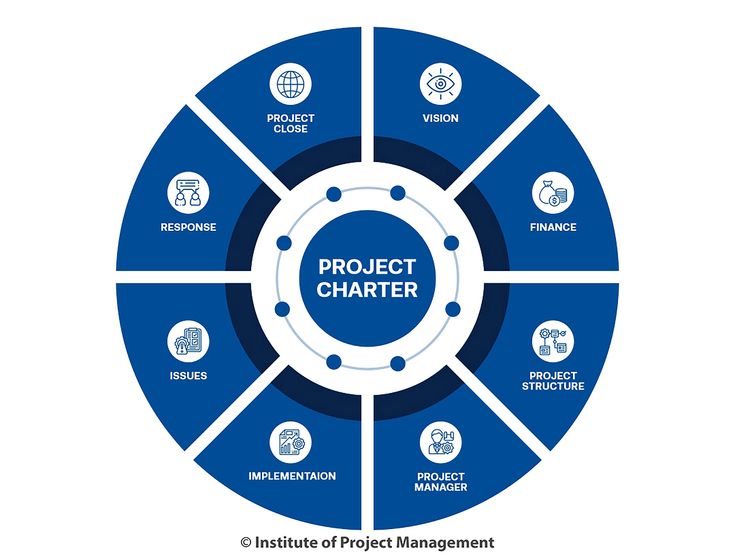
Below is the complete project charter template used in Lagos Data School’s project management training. Each component is listed with its purpose and a Nigerian example drawn from a fictional Lagos e-health platform project.
1. Project Title
A specific, descriptive project title is chosen. Vague names such as “New System” must be avoided. Nigerian example: “Lagos State E-Health Patient Records Platform — Phase 1.”
2. Project Purpose and Business Need
This section answers: “Why is this project being done?” The business problem being addressed is clearly stated. Nigerian example: “Patient records at Lagos University Teaching Hospital are currently paper-based. As a result, record retrieval takes up to forty-eight hours, and medication errors occur. This project will deliver a digital records platform that reduces retrieval time to under two minutes and eliminates paper-based medication errors.”
3. Project Objectives
Objectives are written in SMART format: Specific, Measurable, Achievable, Relevant, and Time-bound. Furthermore, each objective is tied to a measurable success criterion. Nigerian example: “Deploy a fully tested e-health records system across three LASUTH wards by Q2 2025, serving 1,200 daily active users with 99.9% uptime.”
4. Project Scope
The scope is divided into in-scope and out-of-scope items. Both must be stated explicitly. Nigerian example — In-scope: digital patient registration, ward-based records access, and pharmacist dispensing module. Out-of-scope: telemedicine features, billing integration, and mobile app version.
5. Deliverables
Tangible outputs are listed specifically. Nigerian example deliverables: (1) Patient registration portal, (2) Ward-level records access terminals, (3) System user training manual, (4) UAT sign-off report.
6. Milestones
Key project checkpoints are listed with target dates. Nigerian example: Design approved (Week 3), Backend API ready (Week 7), UAT complete (Week 11), Go-live (Week 14).
7. Budget Summary
A high-level cost estimate is provided. Detailed line items are not required at this stage. Nigerian example: “Total estimated budget: ₦22,000,000, covering development, infrastructure, training, and contingency.”
8. Project Sponsor
The executive authorising and funding the project is named. Their title and department are included. Importantly, the sponsor is the ultimate escalation authority for any unresolved project issues.
9. Project Manager
The project manager’s name, contact, and authority level are stated. For example, it is noted whether the project manager can approve budget changes below ₦500,000 without sponsor approval.
10. Key Stakeholders
All affected individuals and groups are listed. This list is used as the starting point for the stakeholder register. Moreover, each stakeholder’s involvement level (informed, consulted, responsible, or accountable) may be noted.
11. Risks and Constraints
Known high-level risks and limitations are documented. Nigerian example risk: “NHIS integration API may not be available until Q3.” Nigerian example constraint: “The platform must comply with NITDA’s data localisation policy before launch.”
12. Assumptions
Conditions assumed to be true for planning purposes are listed. Nigerian example: “It is assumed that stable internet connectivity will be available in all three LASUTH wards throughout the project.”
13. Approval Signatures
The sponsor’s signature is required to formalise the charter. Additionally, the project manager and key stakeholder signatures may be included. Without the sponsor’s signature, the charter is not formally approved, and the project manager has no official authority to act.
Project Charter vs Project Plan: Key Differences
| Feature | Project Charter | Project Plan |
| Phase | Initiation | Planning |
| Purpose | Authorises the project | Guides execution |
| Length | 1–2 pages | Many pages |
| Detail level | High-level overview | Detailed and comprehensive |
| When created | Before team is assembled | After charter is approved |
| Nigerian example | Signed by CEO before kickoff | Built by PM with the full team |
A Nigerian Analogy: The Land Title Before the Foundation
Think of the project charter as the Certificate of Occupancy for a new building plot in Lekki. Before any foundation is laid or any contractor is mobilised, the land title must be signed and sealed. It establishes who owns the land, what can be built on it, and who has authority to proceed.
On the other hand, starting a project without a charter is like a contractor who begins pouring concrete based on a verbal instruction. When disputes arise — and they always do — there is no signed document to refer back to. Consequently, Nigerian project managers who write clear charters are the ones whose projects are delivered without conflict.
Free Resource: PMI’s Project Charter Template
In addition to Lagos Data School’s live training, Lagos Data School recommends the PMI PMBOK® Guide as the most authoritative free reference for Nigerian project managers who want to understand project charters in depth. The PMBOK® Guide defines the Develop Project Charter process completely, including all inputs, tools, techniques, and outputs. Furthermore, it is the reference used in both the PMP and CAPM certification exams. As a result, any Nigerian who studies it alongside Lagos Data School’s live training will be equipped to write professional charters at a certified level.
How Lagos Data School Teaches Project Charter Writing
Lagos Data School’s project management course covers the project charter in the initiation module with live instruction, real Nigerian case studies, and hands-on charter drafting exercises. Students produce complete charters for simulated Nigerian projects. Additionally, exam-standard PMP questions on project initiation are covered in every mock session. In short, Lagos Data School builds the initiation skills that pass the PMP exam and work in real Nigerian organisations.
To enrol, visit the Lagos Data School training page. Explore our graduates’ project documentation work at the Lagos Data School student portfolio.
Frequently Asked Questions: Project Charter Writing
Q1: How Long Should a Project Charter Be?
A project charter is typically one to two pages for simple projects and up to five pages for complex ones. However, brevity is valued. Only the information needed for authorisation must be included. In short, a concise charter is more useful than a long, padded one.
Q2: Who Writes the Project Charter?
The project charter is usually written by the project manager with input from the sponsor and subject matter experts. However, it is the sponsor who signs and formally approves the document. In short, the project manager drafts it, but the sponsor owns it.
Project Charter Mastered: Now Build Your Career at Lagos Data School
Ultimately, the project charter is the document that separates professionally managed Nigerian projects from informally started ones. Every organisation — from Lagos fintech startups to Abuja government agencies- benefits from projects that are formally initiated, scoped, and authorised.
Therefore, take your next step today. Visit Lagos Data School and enrol in the project management course. As a result, project charters, stakeholder management, scope control, and every other initiation skill will become clear, certified tools in your Nigerian career toolkit.