
How to Write a Project Charter: Template + Examples

Are you unsure how to write a project charter? If so, your search ends here. Lagos Data School is Nigeria’s leading live technology and data training centre. Indeed, the project charter is the document that officially authorises a project to begin and grants the project manager the authority to apply organisational resources. Without a properly written charter, Nigerian projects are started informally, scope boundaries are blurred, and stakeholder expectations are misaligned from day one.

Therefore, this guide explains every component of a professional project charter, provides a usable template, and illustrates each section with a Nigerian example. In addition, the differences between a project charter and a project plan are clarified. As a result, by the end of this guide, a complete project charter will be ready to be written from scratch.


What Is a Project Charter and Why Is It Needed?

A project charter is a short, formal document produced during the project initiation phase. It is used to define the project’s purpose, objectives, scope, deliverables, stakeholders, budget, and authority structure. Furthermore, it is signed by the project sponsor to confirm that the project is officially approved and funded.

According to the Project Management Institute’s PMBOK® Guide, the Develop Project Charter process is the first process in the Initiating Process Group. Consequently, no project should be started in any Nigerian organisation without a signed charter in place.

In short, the project charter is the foundation document. Everything else — the project plan, the schedule, the budget, the team — is built on top of it.


The Project Charter Template: All Thirteen Components

Below is the complete project charter template used in Lagos Data School’s project management training. Each component is listed with its purpose and a Nigerian example drawn from a fictional Lagos e-health platform project.

1. Project Title

A specific, descriptive project title is chosen. Vague names such as “New System” must be avoided. Nigerian example: “Lagos State E-Health Patient Records Platform — Phase 1.”

2. Project Purpose and Business Need

This section answers: “Why is this project being done?” The business problem being addressed is clearly stated. Nigerian example: “Patient records at Lagos University Teaching Hospital are currently paper-based. As a result, record retrieval takes up to forty-eight hours, and medication errors occur. This project will deliver a digital records platform that reduces retrieval time to under two minutes and eliminates paper-based medication errors.”

3. Project Objectives

Objectives are written in SMART format: Specific, Measurable, Achievable, Relevant, and Time-bound. Furthermore, each objective is tied to a measurable success criterion. Nigerian example: “Deploy a fully tested e-health records system across three LASUTH wards by Q2 2025, serving 1,200 daily active users with 99.9% uptime.”

4. Project Scope

The scope is divided into in-scope and out-of-scope items. Both must be stated explicitly. Nigerian example — In-scope: digital patient registration, ward-based records access, and pharmacist dispensing module. Out-of-scope: telemedicine features, billing integration, and mobile app version.

5. Deliverables

Tangible outputs are listed specifically. Nigerian example deliverables: (1) Patient registration portal, (2) Ward-level records access terminals, (3) System user training manual, (4) UAT sign-off report.

6. Milestones

Key project checkpoints are listed with target dates. Nigerian example: Design approved (Week 3), Backend API ready (Week 7), UAT complete (Week 11), Go-live (Week 14).

7. Budget Summary

A high-level cost estimate is provided. Detailed line items are not required at this stage. Nigerian example: “Total estimated budget: ₦22,000,000, covering development, infrastructure, training, and contingency.”

8. Project Sponsor

The executive authorising and funding the project is named. Their title and department are included. Importantly, the sponsor is the ultimate escalation authority for any unresolved project issues.

9. Project Manager

The project manager’s name, contact, and authority level are stated. For example, it is noted whether the project manager can approve budget changes below ₦500,000 without sponsor approval.

10. Key Stakeholders

All affected individuals and groups are listed. This list is used as the starting point for the stakeholder register. Moreover, each stakeholder’s involvement level (informed, consulted, responsible, or accountable) may be noted.

11. Risks and Constraints

Known high-level risks and limitations are documented. Nigerian example risk: “NHIS integration API may not be available until Q3.” Nigerian example constraint: “The platform must comply with NITDA’s data localisation policy before launch.”

12. Assumptions

Conditions assumed to be true for planning purposes are listed. Nigerian example: “It is assumed that stable internet connectivity will be available in all three LASUTH wards throughout the project.”

13. Approval Signatures

The sponsor’s signature is required to formalise the charter. Additionally, the project manager and key stakeholder signatures may be included. Without the sponsor’s signature, the charter is not formally approved, and the project manager has no official authority to act.


Project Charter vs Project Plan: Key Differences

Feature Project Charter Project Plan
Phase Initiation Planning
Purpose Authorises the project Guides execution
Length 1–2 pages Many pages
Detail level High-level overview Detailed and comprehensive
When created Before team is assembled After charter is approved
Nigerian example Signed by CEO before kickoff Built by PM with the full team


A Nigerian Analogy: The Land Title Before the Foundation

Think of the project charter as the Certificate of Occupancy for a new building plot in Lekki. Before any foundation is laid or any contractor is mobilised, the land title must be signed and sealed. It establishes who owns the land, what can be built on it, and who has authority to proceed.

On the other hand, starting a project without a charter is like a contractor who begins pouring concrete based on a verbal instruction. When disputes arise — and they always do — there is no signed document to refer back to. Consequently, Nigerian project managers who write clear charters are the ones whose projects are delivered without conflict.


Free Resource: PMI’s Project Charter Template

In addition to Lagos Data School’s live training, Lagos Data School recommends the PMI PMBOK® Guide as the most authoritative free reference for Nigerian project managers who want to understand project charters in depth. The PMBOK® Guide defines the Develop Project Charter process completely, including all inputs, tools, techniques, and outputs. Furthermore, it is the reference used in both the PMP and CAPM certification exams. As a result, any Nigerian who studies it alongside Lagos Data School’s live training will be equipped to write professional charters at a certified level.


How Lagos Data School Teaches Project Charter Writing

Lagos Data School’s project management course covers the project charter in the initiation module with live instruction, real Nigerian case studies, and hands-on charter drafting exercises. Students produce complete charters for simulated Nigerian projects. Additionally, exam-standard PMP questions on project initiation are covered in every mock session. In short, Lagos Data School builds the initiation skills that pass the PMP exam and work in real Nigerian organisations.

To enrol, visit the Lagos Data School training page. Explore our graduates’ project documentation work at the Lagos Data School student portfolio.


Frequently Asked Questions: Project Charter Writing

Q1: How Long Should a Project Charter Be?

A project charter is typically one to two pages for simple projects and up to five pages for complex ones. However, brevity is valued. Only the information needed for authorisation must be included. In short, a concise charter is more useful than a long, padded one.

Q2: Who Writes the Project Charter?

The project charter is usually written by the project manager with input from the sponsor and subject matter experts. However, it is the sponsor who signs and formally approves the document. In short, the project manager drafts it, but the sponsor owns it.


Project Charter Mastered: Now Build Your Career at Lagos Data School

Ultimately, the project charter is the document that separates professionally managed Nigerian projects from informally started ones. Every organisation — from Lagos fintech startups to Abuja government agencies- benefits from projects that are formally initiated, scoped, and authorised.

Therefore, take your next step today. Visit Lagos Data School and enrol in the project management course. As a result, project charters, stakeholder management, scope control, and every other initiation skill will become clear, certified tools in your Nigerian career toolkit.
Stakeholder Management Strategies: Complete 2026 Guide

Are you struggling with stakeholder management on your Nigerian projects? If so, your search ends here. Lagos Data School is Nigeria’s leading live technology and data training centre. Indeed, stakeholder management is one of the most politically sensitive and most underestimated knowledge areas in project management.  Stakeholder management.

Therefore, this guide explains who stakeholders are, how they are identified and analysed, and which strategies are used to engage them effectively. In addition, Nigerian examples are used throughout.


What Is Stakeholder Management?

Stakeholder management is the process of identifying all individuals and groups affected by a project, understanding their interests and influence, and developing strategies to engage them in a way that supports the project’s success. Furthermore, it is a continuous process that runs from project initiation through to closure.

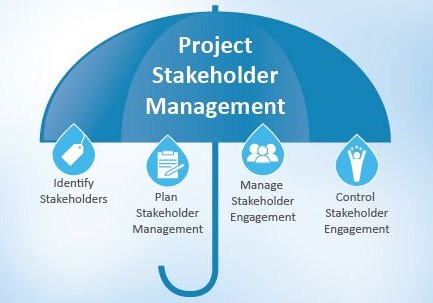
According to the Project Management Institute’s PMBOK® Guide, the Project Stakeholder Management knowledge area consists of four processes: Identify Stakeholders, Plan Stakeholder Engagement, Manage Stakeholder Engagement, and Monitor Stakeholder Engagement. Additionally, each process produces key outputs that are used throughout the project lifecycle.


Why Stakeholder Management Is Uniquely Challenging in Nigeria

Nigerian projects exist within a complex web of formal authority, informal influence, community expectations, and political dynamics. Consequently, Nigerian project managers must navigate stakeholder relationships that are rarely captured in a standard org chart. Below are the key stakeholder challenges that are commonly encountered on Nigerian projects:

  • The powerful informal influencer: A senior executive or traditional ruler who holds no formal project role but whose opinion can stop a project overnight must be identified and engaged proactively.
  • Community resistance: Infrastructure projects in Nigerian states often face community opposition driven by land disputes, employment expectations, or distrust of developers. Therefore, community stakeholders must be engaged before ground is broken.
  • Regulatory bodies: NAFDAC, NESREA, the CBN, NITDA, and other Nigerian regulators are powerful stakeholders whose requirements must be understood and satisfied before project activities can proceed.
  • Funders and development partners: World Bank, AfDB, or USAID-funded projects in Nigeria require regular, structured reporting to international stakeholders who are not physically present on site.
  • Internal politics: Competing departments within Nigerian organisations often have conflicting interests in a shared project. Consequently, the project manager must balance internal stakeholder rivalries without taking sides.


In short, stakeholder management in Nigeria requires cultural intelligence, political awareness, and structured documentation in equal measure.


Step 1: Identify All Stakeholders

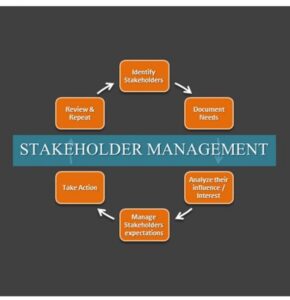
Stakeholder identification is conducted during project initiation and is revisited at the start of each major phase. Every individual or group that is affected by the project, or that can affect the project, must be identified and documented in the stakeholder register. Furthermore, both internal and external stakeholders must be included.

Sources of stakeholder identification include: the project charter, the organisational chart, government regulations, community engagement records from similar past projects, and interviews with the project sponsor and functional managers.


Step 2: Analyse Stakeholders Using the Power-Interest Grid

Each identified stakeholder is analysed on two dimensions: their level of power (ability to influence the project) and their level of interest (degree to which they are affected by the project). The Power-Interest Grid categorises stakeholders into four quadrants:

Quadrant Power / Interest Engagement Strategy
Manage Closely High power, high interest Engage actively. Involve in key decisions. Update frequently.
Keep Satisfied High power, low interest Keep informed at a high level. Avoid surprising them.
Keep Informed Low power, high interest Share regular updates. Address their concerns promptly.
Monitor Low power, low interest Monitor passively. Minimal formal engagement required.


In short, not all stakeholders require the same level of engagement.


Step 3: Develop the Stakeholder Engagement Plan

A Stakeholder Engagement Plan is created to document the communication and engagement approach for each stakeholder or stakeholder group. It specifies: what information is communicated, how frequently it is communicated, in what format it is delivered, and who is responsible for the communication. Furthermore, the current engagement level of each stakeholder is assessed and compared with the desired engagement level so that gaps are identified and addressed.

For Nigerian projects, the Stakeholder Engagement Plan must account for local preferences.


Step 4: Manage and Monitor Stakeholder Engagement

Stakeholder engagement is managed throughout the project by implementing the communication plan, hosting stakeholder meetings, resolving concerns, and documenting all significant stakeholder interactions. Additionally, the stakeholder register is updated whenever a stakeholder’s power, interest, or engagement level changes.

Monitoring is conducted at regular intervals. The project manager assesses whether each stakeholder’s current engagement level matches the desired level.


A Nigerian Analogy: The Aso-Ebi List at a Lagos Wedding

Think of stakeholder management as the coordination of a Lagos wedding guest list. Not every guest is treated the same. The parents of the couple sit at the high table (Manage Closely). The influential aunty who is not on the planning committee must still be kept informed and never surprised (Keep Satisfied). Family friends who follow the event on Instagram are monitored but require no direct engagement (Monitor).

On the other hand, a wedding planner who treats all guests equally, sending the same message to everyone, at the same frequency, in the same format will confuse, miss VIP expectations, and create unnecessary drama. Therefore, Nigerian project managers who segment and tailor their stakeholder engagement are the ones whose projects proceed without political disruption.


Free Resource: PMI’s Stakeholder Engagement Assessment Matrix

In addition to Lagos Data School’s live training, Lagos Data School recommends the PMI PMBOK® Guide for the Stakeholder Engagement Assessment Matrix tool, which is used to compare current and desired stakeholder engagement levels across the full stakeholder register. This tool is described in the Project Stakeholder Management knowledge area and is tested in the PMP exam. Furthermore, it is freely accessible to PMI members. As a result, any Nigerian project manager who uses this tool alongside Lagos Data School’s live training will approach every stakeholder conversation with structure and confidence.


How Lagos Data School Teaches Stakeholder Management

Lagos Data School’s project management course covers stakeholder management in a dedicated module with live instruction, Nigerian case studies, and hands-on stakeholder register and engagement plan exercises. Students build stakeholder registers and Power-Interest Grids for simulated Lagos fintech, construction, and government projects. Additionally, stakeholder communication planning is practised using real Nigerian project scenarios. In short, Lagos Data School builds the stakeholder management skills that pass the PMP exam and that every Nigerian project manager needs in the field.

To enroll, visit the Lagos Data School training page. See how our graduates apply stakeholder management across industries in the Lagos Data School student portfolio.


Frequently Asked Questions: Stakeholder Management in Nigeria

Q1: What Is a Stakeholder Register?

A stakeholder register is a document that lists all identified project stakeholders along with their contact details, role, power level, interest level, current engagement level, and desired engagement level.  In short, the stakeholder register is the central reference document for all stakeholder management activities.

Q2: How Often Should Stakeholders Be Engaged on a Nigerian Project?

Engagement frequency is determined by the Stakeholder Engagement Plan. Typically, high-power, high-interest stakeholders are engaged weekly or at every major milestone. On the other hand, low-power, low-interest stakeholders may only receive monthly summary updates. Furthermore, any significant project change or risk event triggers immediate communication to all affected stakeholders regardless of their normal engagement frequency.

Q3: What If a Key Stakeholder Is Resistant to the Project?

Resistance must be addressed proactively rather than ignored. The root cause of the resistance is identified through one-on-one conversation, and the stakeholder’s concerns are formally documented and escalated if needed. Additionally, the project sponsor may be engaged to help resolve conflicts between resistant stakeholders and the project team. In short, unaddressed resistance always escalates. Consequently, it must be managed early.


Stakeholder Management Mastered: Now Build Your Career at Lagos Data School

Ultimately, stakeholder management is the skill that keeps Nigerian projects politically viable. A perfectly scheduled, well-resourced project can still be stopped by a single powerful stakeholder who feels ignored. Consequently, Nigerian project managers who invest in structured stakeholder engagement protect their projects from political disruption at every level.

Therefore, take your next step today. Visit Lagos Data School and enrol in the project management course. As a result, stakeholder registers, engagement plans, Power-Interest Grids, and every other stakeholder management tool will become clear, certified skills in your Nigerian project management career.

Hi, How Can We Help You?
Welcome To
Lagos Data School

Artificial Intelligence (AI), Machine Learning and Robotics Programmes Are Now Available!!!

Enroll Now!

Thank You
100% secure website.