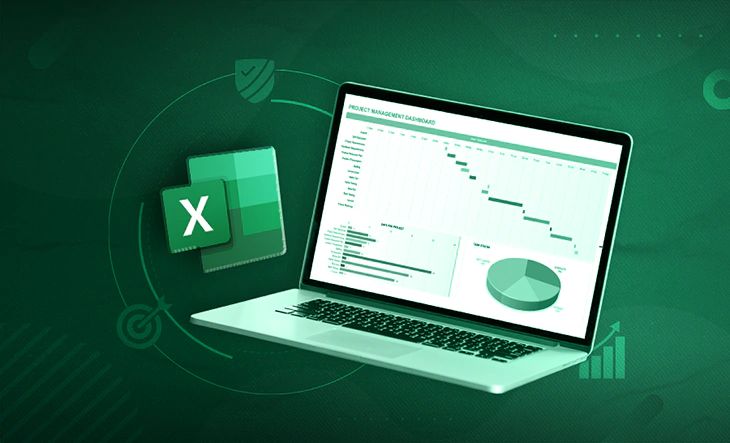
In many cases, Nigerian data analysts begin with Excel. Thus, it is the tool that comes first. It is what the office uses. It is what the job listing asks for. And it is genuinely useful for a large number of real tasks.
But at some point, Excel is not enough. The data gets too large. The questions get too complex. The answers need to update on their own. And the team starts asking for models, not just charts.
That is the moment when the journey from Excel to machine learning begins. This guide is a clear, practical roadmap for that journey. It is made for Nigerian analysts who are good at Excel and want to move toward predictive analytics without wasting time or losing direction.
Lagos Data School made this guide based on the learning paths of hundreds of Nigerian analysts who have gone through this transition. We know where people get stuck. We know what works. And we have laid it all out here in a clear sequence.
Why Make the Move at All?
This is a fair question. Excel is powerful. It is familiar. And it runs on every computer in every Nigerian office. Why go through the effort of learning something new?

The honest answer is that there is a ceiling. Excel can handle tens of thousands of rows well. But Nigerian fintech firms, telecoms, banks, and retail companies now work with millions of rows of data every single day. Excel was not built for that scale.
Beyond scale, there is complexity. Excel can compute sums, averages, and basic charts. But it cannot build a model that learns from past data and makes predictions about what will happen next. It cannot run on its own. And it cannot be set up as a live system that updates its own forecasts every hour.
Machine learning does all of these things. And the analysts who can do them are in high demand and earn more than those who cannot.
Stage 1: Get Excel Right First
Before you move away from Excel, make sure you have truly mastered it. This matters because the thinking skills behind good Excel work are the same skills you need for data analytics at any level.
At a minimum, you should be comfortable with VLOOKUP and INDEX-MATCH, pivot tables and pivot charts, conditional formatting and data validation, and basic functions like AVERAGE, STDEV, CORREL, and FORECAST. You should also be able to clean a messy dataset in Excel without help.
If you can do all of these things well and quickly, you are ready to move forward. If any of these feel shaky, spend two to four weeks on them first. A strong Excel base makes every later step easier, not harder.
Stage 2: Learn SQL
SQL is the language of databases. Before you write a single line of Python or build any model, you need to be able to pull data from a database and shape it into the form you need for analysis.
In Nigerian business settings, data rarely comes to you in a clean Excel file. It lives in a database or a data warehouse. SQL is the skill that lets you access it.
Learning SQL takes most motivated beginners between four and eight weeks with daily practice. Focus on SELECT, WHERE, GROUP BY, ORDER BY, JOIN, and subqueries. These cover the large majority of real-world data tasks.
Once you can write a clean SQL query to pull and group the data you need, you are ready for the next step. Do not rush past this stage. It pays off at every later level of the career.
Stage 3: Learn Python Basics
Python is the main language of data analytics and machine learning across the world. It is also the language that Lagos Data School teaches across all of our data science programs, because it is the most useful tool for the work Nigerian analysts need to do.
You do not need to become a software developer. You need to become comfortable using Python as a tool for data work. The key areas to cover are: variables and data types, loops and functions, reading and writing files, and working with lists and dictionaries.
Most analysts can cover these basics in four to six weeks with daily practice. The goal at this stage is not speed or elegance. The goal is comfort. You should be able to sit down with a Python script and follow what it is doing, line by line.
Stage 4: Learn pandas and Data Shaping
Once you know Python basics, the next step is pandas. Pandas is a Python library that lets you work with tabular data, the kind of data that looks like a spreadsheet, in a very flexible and powerful way.
With pandas, you can load a CSV file, clean missing values, filter rows, group data, merge tables, and create new columns based on calculations. If you have done these things in Excel, you will recognise the ideas right away. Pandas simply lets you do them at a much larger scale and with far more control.
Spend four to six weeks learning pandas deeply. Work with real datasets, not toy examples. Find a Nigerian business dataset, such as transaction records or sales data, and use it to practice every key pandas operation. This is how the skill becomes real and lasting.
Stage 5: Learn Data Visualization
Data that cannot be explained clearly is data that does not drive decisions. This is as true for machine learning output as it is for Excel charts.
Learn to create clear, useful charts in Python using matplotlib and seaborn. Focus on line charts for time series data, bar charts for comparisons, scatter plots for relationships between variables, and histograms for distributions. These four chart types cover the large majority of real-world data needs.
Beyond the mechanics of creating charts, spend time thinking about how to explain your findings clearly to a non-technical audience. A chart that makes perfect sense to you may be completely confusing to the finance director who needs to act on it. Clear communication is a core professional skill, not a nice-to-have.
Stage 6: Learn the Statistics You Need
You do not need a university statistics degree to use machine learning. But you do need a working understanding of a small number of core ideas. Without these, you will build models without knowing why they work, and you will not know how to fix them when they go wrong.
The core ideas you need are mean, median, and standard deviation; correlation and what it does and does not tell you; the difference between a continuous and a category variable; what a distribution is and what a normal distribution looks like; and the basic idea behind a p-value.
Most analysts can cover these ideas solidly in three to four weeks. Lagos Data School covers all of them as part of our analytics foundations module, using real Nigerian business examples throughout.
Stage 7: Build Your First Predictive Models
This is the stage that most people think of when they hear the words machine learning. But as you can see from this roadmap, it is stage seven of an eight-stage journey, not the starting point.
Start with linear regression. It is the simplest predictive model and also one of the most useful in real Nigerian business settings. Learn what it does, how to build it in Python using scikit-learn, how to check its accuracy, and how to explain its output in plain terms.
Then move to logistic regression for yes/no prediction problems. Then decision trees. Following that, random forests, which are an extended version of decision trees that often perform much better in practice.
At each step, use real data and answer a real question. Do not just run code. Ask: what does this model actually tell me? Is the answer believable? What would a business do with this prediction?
Stage 8: Specialize and Go Deep
Once you have a solid base in the core tools, the final stage is specialization. Choose a domain that fits the kind of work you want to do and go deep in it.
If you want to work in Nigerian fintech, go deep in credit risk modeling and fraud detection. If you want to work in supply chain or manufacturing, go deep in demand forecasting and predictive maintenance. To work in marketing or retail, go deep into customer grouping and churn prediction.
Specialization is what separates analysts who are truly valuable to a specific type of employer from those who are generally competent. General competence gets you an entry-level role. Deep specialization gets you promoted and paid at a level that reflects real scarcity in the market.
A Realistic Timeline for the Full Journey
| Stage | Topic | Time Needed |
| 1 | Excel mastery | 2–4 weeks (skip if already solid) |
| 2 | SQL basics to intermediate | 4–8 weeks |
| 3 | Python basics | 4–6 weeks |
| 4 | pandas and data shaping | 4–6 weeks |
| 5 | Data visualization | 2–3 weeks |
| 6 | Statistics for data analysis | 3–4 weeks |
| 7 | Predictive modeling fundamentals | 6–8 weeks |
| 8 | Specialization and deepening | Ongoing |
The full journey from Excel to genuine machine learning capability takes between six months and one year for most motivated learners, depending on how much time you can give each week. Most people who do this well dedicate between one and two hours per day to deliberate study and practice.
Lagos Data School speeds up this timeline through structured, hands-on training with real Nigerian datasets, mentorship from working professionals, and a community of Nigerian analysts on the same path.
Where People Get Stuck and How to Get Past It
Lagos Data School has guided hundreds of Nigerian analysts through this journey. Here are the most common sticking points and how to get past them.
Stuck at Python Syntax
Many people who are comfortable in Excel find Python syntax confusing at first. The fix is simple: stop trying to memorize syntax and start practicing by writing real code every day. Fluency comes from repetition, not from reading. Write ten to twenty lines of Python every single day for one month, and the sticking point will pass.
Stuck on Statistics
Statistics feels abstract until you tie it to a real question. The trick is to always start with a business question, not a formula. Ask: do higher-income customers buy more often? Then learn how to answer that question statistically. The formula makes sense once you know what question it is trying to answer.
Stuck on Which Model to Use
This is one of the most common questions Lagos Data School hears. The honest answer: start with the simplest model that could work. Only move to a more complex one if the simple model is not accurate enough. Linear regression for numbers. Logistic regression for yes/no decisions. Decision trees when you need to explain the model’s logic to a non-technical audience.
The Plain Summary
Here is the whole roadmap in the simplest possible terms.
Start with Excel. Get it solid. Then learn SQL so you can get data. Learn Python to handle data at scale. Master pandas so you can shape data effectively. Then learn to show data as clear charts. Learn the statistics you need. Then build your first models. Then specialize.
Each step builds on the last one. None of them is optional. And none of them is beyond the reach of a motivated Nigerian analyst who is willing to put in consistent daily effort.
Lagos Data School runs structured programs that take you through exactly this sequence. Real Nigerian datasets. Working professionals as your guides. A community of analysts on the same path.
Start. One stage at a time. Go.
Recommended External Resource
For a free, comprehensive Python and machine learning resource used by analysts globally, visit Kaggle Learn: https://www.kaggle.com/learn.
A Readiness Self-Check
Before moving from one stage to the next, ask yourself these three questions.
- Can I do this task without looking anything up?
- Will it be possible for me to explain what I just did to someone who has never done it before?
- Can I apply this skill to a dataset I have never seen before?
If you can answer yes to all three, you are ready to move forward. If any answer is no, spend one more week practicing before you move on. The time you spend at each stage builds into real, lasting skill. Rushing through a stage always costs more time later than it saves now.
Lagos Data School builds this kind of mastery-based progression into all of our data analytics programs. We do not move students forward until they are genuinely ready.
About Lagos Data School
Lagos Data School is Nigeria’s top school for cybersecurity, data science, cloud, and analytics. Every idea in this guide is part of our hands-on course.
Our teachers are real security pros, not just classroom staff. So you learn from people who guard live networks every day.
We run classes on weekdays, weekends, and online. So no matter your time, we have a slot for you. Beyond skills, we also give you a real certificate and links to job partners.
Additionally, visit Lagos Data School today to view our courses and join the next class.
Start the journey today. Train with Lagos Data School.