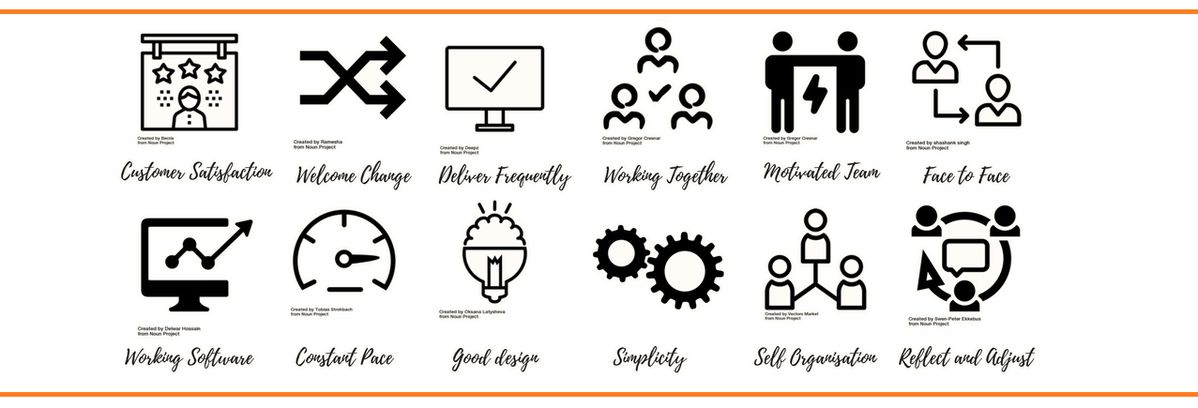
The 12 Principles of the Agile Manifesto: Complete Guide

The 12 Agile Principles: What Every Nigerian Project Manager Must Know

The Agile Manifesto was written in 2001 by seventeen software experts. It contains four values and twelve principles. Lagos Data School teaches every principle to Nigerian project management students. Therefore, this guide explains each principle in plain, short language.

This may contain: the different types of business icons

Also, each principle is linked to a Nigerian work example. By the end, you will understand Agile well enough to apply it from day one.


The Four Core Agile Values

Before the twelve principles, the Manifesto states four core values. Each value places one thing above another. However, Agile does not reject the less-valued items. Instead, it simply prioritises the more valuable ones.


Agile Values This More… …Than This
Individuals and interactions Processes and tools
Working software Comprehensive documentation
Customer collaboration Contract negotiation
Responding to change Following a fixed plan


According to the official Agile Manifesto, these values guide the twelve principles. Furthermore, understanding the values helps you apply the principles correctly.


Principles 1 to 3: Deliver Value to the Customer


Principle 1: Deliver Working Products Early and Often

Agile teams deliver working results early and keep delivering continuously. In fact, early delivery is the number one goal of every Agile team. For example, a Lagos fintech team releases a basic payment feature in week two. Consequently, customers test and give feedback right away. Therefore, the next sprint is shaped by real users rather than assumptions. In short, early delivery builds client trust faster than any status report.


Principle 2: Welcome Changing Requirements

Agile teams welcome change even late in the project. In fact, this flexibility gives clients a real competitive advantage. For example, a client asks to add USSD support midway through an app build. Therefore, an Agile team adds it to the backlog and includes it in the next sprint.

As a result, scope flexibility becomes a feature rather than a problem. However, this only works when change requests go through the product owner first.


Principle 3: Deliver Working Products Frequently

Teams should ship a working product every one to four weeks. In addition, short delivery cycles beat long ones every time. For example, a two-week sprint keeps a Lagos development team focused and accountable.

Moreover, clients see real progress regularly rather than waiting months for a demo. Consequently, trust between the client and the team grows with every sprint.


Principles 4 to 6: Build Great Teams


Principle 4: Business and Developers Must Work Together Daily

Product owners and developers must talk every single working day. In fact, silos between business and tech are one of the main reasons projects fail. For example, a product manager at an Abuja startup joins the daily stand-up every morning. Therefore, business priorities are always clear to the development team.

As a result, the team builds the right things without waiting for weekly meetings.


Principle 5: Build Projects Around Motivated People

Great Agile teams need trust, support, and the right tools. Furthermore, micromanagement kills motivation and slows delivery. For example, a Lagos project manager gives the team autonomy over their own sprint plan. Consequently, ownership increases and output quality improves as well. Therefore, give your team what they need and then trust them to deliver.


Principle 6: Face-to-Face Conversation Is the Best Communication

Talking directly beats sending long emails every time. In fact, most project misunderstandings come from written messages without context. For example, sitting together in a Lagos co-working space beats a twenty-message WhatsApp thread.

Moreover, face-to-face conversations resolve conflict much faster. Therefore, Agile teams always prefer a quick call or meeting over a long document.


Principles 7 to 9: Focus on Quality and Pace


Principle 7: Working Software Is the Only True Measure of Progress

Status reports and slide decks do not prove progress. In fact, only a working product tells you where you truly stand. For example, a Lagos e-commerce team does not celebrate a design document. Instead, they celebrate when the checkout flow works and users can buy products. Therefore, always demo a working feature at the end of every sprint.


Principle 8: Maintain a Sustainable Development Pace

Agile teams work at a pace they can keep up indefinitely. In fact, burnout is one of the biggest killers of long-term team performance. For example, late-night coding every week hurts both quality and morale. Therefore, sprint planning must protect the team from unsustainable workloads. As a result, a well-paced team consistently outperforms an overworked one.


Principle 9: Continuous Attention to Technical Excellence

Clean code and good design keep teams fast. In contrast, technical shortcuts slow everything down over time. For example, a Port Harcourt software team refactors messy code every sprint. Consequently, adding new features becomes faster rather than harder as the project grows. Therefore, invest in code quality from sprint one rather than fixing it later.


Principles 10 to 12: Stay Simple and Keep Improving


Principle 10: Simplicity — Build Only What Is Needed

Agile teams build only what the client needs right now. In fact, extra features that no one asked for waste time and money. For example, a Lagos startup team resists adding a complex dashboard in sprint one. Instead, they focus on the core features that users actually need first. Therefore, every sprint item must be tied to a real user or business need.


Principle 11: Self-Organising Teams Produce the Best Results

The best work comes from teams that manage themselves. In fact, self-organising teams take ownership and deliver with more creativity. For example, a Lagos product team plans its own sprint tasks without waiting for assignments.

As a result, both team ownership and output quality rise significantly. Therefore, trust your team to manage their own work within the sprint boundaries.


Principle 12: Reflect and Improve at Regular Intervals

Teams must stop regularly to review how they are working. In fact, continuous improvement is at the heart of Agile.

For example, a Lagos Scrum team holds a retrospective at the end of every sprint. Consequently, they identify three things to improve and act on them immediately. Therefore, every sprint produces better results than the one before it.


All 12 Agile Principles at a Glance

Use this quick reference table in your daily project work.


# Principle Nigerian Example
1 Deliver value early and continuously Release features every sprint in Lagos
2 Welcome changing requirements Add USSD support mid-sprint without drama
3 Deliver working products frequently Ship every two weeks, not every six months
4 Business and dev collaborate daily Product manager joins the daily stand-up
5 Build around motivated individuals Give the team autonomy over sprint planning
6 Prefer face-to-face communication Talk directly rather than sending long emails
7 Working product = real progress Demo a live feature, not a slide deck
8 Maintain a sustainable pace Protect the team from late-night sprints
9 Focus on technical excellence Refactor code every sprint in Port Harcourt
10 Simplicity — build only what is needed Skip the complex dashboard in sprint one
11 Self-organising teams deliver the best work Team plans its own tasks without micromanagement
12 Reflect and improve at regular intervals Retrospective every two weeks in Lagos


Why These Principles Matter for Nigerian Project Managers

Many Nigerian teams adopt Agile tools like Trello or Jira without understanding the principles. Consequently, they get frustrated when the tools do not solve their deeper problems. However, when teams understand the principles first, the tools make complete sense. Therefore, memorising these twelve principles gives you the foundation for every Agile decision.

In addition, PMP and PMI-ACP exams both test your ability to apply these principles in context. As a result, learning the principles is both a career investment and a certification shortcut.


Common Mistakes Nigerian Teams Make with the Agile Principles

Mistake 1: Treating Stand-Ups as Status Meetings

Many Nigerian teams turn the daily stand-up into a long status update. However, Principle 6 says that communication should be short and direct. Therefore, keep the stand-up to ten minutes and three questions only.


Mistake 2: Skipping the Retrospective

Some Nigerian teams skip the retrospective when they are busy. However, Principle 12 says regular reflection is not optional. Consequently, teams that skip retrospectives repeat the same mistakes every sprint. Therefore, protect the retrospective even on busy sprints.


Mistake 3: Ignoring Technical Debt

Many Nigerian developers skip Principle 9 and ship fast without refactoring. As a result, the codebase becomes harder to change with every sprint.

Therefore, set aside at least ten percent of every sprint for code quality work.


Free Resources to Learn More About Agile Principles

Lagos Data School recommends the official Agile Manifesto as a first read. It is free, short, and written by the people who created Agile.

Also, the Scrum Guide by Schwaber and Sutherland is the official free Scrum reference. Furthermore, it maps directly to PMP and PMI-ACP exam content. In addition, Lagos Data School provides notes and exercises on all twelve principles in class.


How Lagos Data School Teaches the 12 Agile Principles

Lagos Data School covers every principle in its live Agile module. Students apply each principle to Nigerian project scenarios in group exercises. Moreover, the course links every principle to a real Scrum ceremony or practice. For example, Principle 12 is practised through a live sprint retrospective exercise.

Therefore, students leave knowing exactly how to apply Agile on a real Nigerian project.

Visit the Lagos Data School training page to enrol. Also, see what graduates have built at the Lagos Data School student portfolio.


Frequently Asked Questions: The 12 Agile Principles

Q1: Do I need to memorise all 12 principles for the PMP exam?

The PMP exam tests your ability to apply the principles, not recite them. Therefore, understanding each principle in context matters more than memorising words. In fact, practising scenario-based questions is far more effective for exam preparation.


Q2: Which principle is hardest for Nigerian teams to follow?

Principle 11 self-organising teams is often the hardest in Nigerian workplaces. In fact, many Nigerian organisations have a strong top-down management culture.

However, teams that adopt self-organisation consistently outperform those that do not. Therefore, Lagos Data School spends extra time on this principle in every training session.


Q3: Can non-tech Nigerian teams apply these principles?

Yes. Every principle applies to any team that plans and delivers work. For example, Nigerian marketing, HR, and events teams all use these principles successfully.

In addition, Agile principles work for government project teams as well. Therefore, the principles are universal — not just for software developers.


Q4: How long does it take to learn Agile principles fully?

You can read and understand all twelve principles in under one hour. However, applying them confidently on a real project takes two to four sprints of practice. Consequently, Lagos Data School combines classroom teaching with live project exercises.

As a result, students leave training ready to apply Agile on day one.


Master Agile Principles with Lagos Data School

The twelve Agile principles are not just theory. In fact, they are the daily habits of the world’s most effective project teams. Lagos Data School teaches you to apply every principle in real Nigerian projects.

Moreover, every session uses Nigerian case studies so that the learning is immediately practical.

Visit Lagos Data School and enrol in the project management course today.
Best Agile Certifications for Project Managers in Nigeria

Agile Certifications in Nigeria: Which One Should You Get?

Agile skills are in high demand across Nigerian tech, finance, and operations sectors. However, not all Agile certifications carry the same weight in Nigeria.

Lagos Data School helps Nigerian professionals choose the right certification. Therefore, this guide compares the top Agile certifications available to Nigerians. In addition, it explains the cost, requirements, and career value of each one. By the end, you will know exactly which certification to pursue first.


Why Agile Certification Matters for Your Nigerian Career

Many Nigerian professionals learn Agile on the job without any formal credential. However, a certification proves your knowledge to employers and clients. Furthermore, certified Agile professionals in Lagos earn significantly more on average. In fact, several Nigerian job posts now list Agile certification as a requirement. Consequently, getting certified moves your CV to the top of the shortlist. Therefore, the return on investment from an Agile certification is very high in Nigeria.


Certification 1: PMI-ACP (PMI Agile Certified Practitioner)

The PMI-ACP is offered by the Project Management Institute. Furthermore, it is one of the most respected Agile certifications in the world.

Story pin image

Visit PMI.org for full details. In addition, the PMI-ACP covers multiple Agile frameworks — not just Scrum. Therefore, it is the best all-round Agile certification for Nigerian project managers.


PMI-ACP Requirements

  • Education: Secondary degree (or higher).
  • General project experience: 2,000 hours of general project management experience.
  • Agile experience: 1,500 hours of Agile project work.
  • Training: 21 contact hours of Agile training.


PMI-ACP Exam and Cost

The exam has 120 questions and lasts three hours. Furthermore, the exam costs $435 USD for PMI members and $495 for non-members.

However, PMI membership costs $139 per year and saves money on the exam fee. Therefore, joining PMI before registering for the exam is the smarter financial choice.


Who Should Get the PMI-ACP in Nigeria?

The PMI-ACP is ideal for experienced Nigerian project managers moving into Agile roles. Also, it suits professionals who already hold a PMP and want to add Agile credentials. Consequently, it is the most career-expanding Agile certification for senior Nigerian professionals.


Certification 2: ICP-ACC (ICAgile Certified Professional — Agile Coaching)

The ICP-ACC is offered by ICAgile. It focuses on Agile coaching skills rather than Agile project management. Visit ICAgile for more.

This may contain: the icp - acc certified professional logo is shown in blue and white, with an

Furthermore, the ICP-ACC is designed for professionals who coach Agile teams. Therefore, it is the right choice for Scrum Masters and team leaders in Nigerian organisations.


ICP-ACC Requirements and Cost

No prior certification is required for the ICP-ACC. However, prior Agile experience and Scrum knowledge are strongly recommended. Furthermore, the course is instructor-led and involves group coaching exercises.

Also, the cost varies by training provider but typically ranges from $1,000 to $2,000 USD. Consequently, it is one of the more affordable specialist Agile coaching certifications available.


Who Should Get the ICP-ACC in Nigeria?

The ICP-ACC is ideal for Scrum Masters and team leads in Nigerian companies. Also, it suits HR professionals who want to facilitate Agile transformation within organisations.

Furthermore, Nigerian consultants who run Agile adoption programmes benefit greatly from this credential.


Certification 3: CSM (Certified ScrumMaster)

The CSM is offered by the Scrum Alliance. It is the most popular entry-level Scrum certification in Nigeria. Visit Scrum Alliance for details.

Furthermore, the CSM is widely recognised by Nigerian tech companies and startups. Therefore, it is the best first Agile certification for Nigerian professionals just starting.


CSM Requirements and Cost

You must attend a two-day Certified Scrum Master course to sit the CSM exam. Furthermore, the course is delivered by a Certified Scrum Trainer (CST).

Also, the exam consists of fifty questions and requires a score of 74% to pass. In addition, the course and exam combined typically cost between $500 and $1,000 USD. Consequently, the CSM is one of the most accessible Agile certifications for Nigerian beginners.


Who Should Get the CSM in Nigeria?

The CSM is ideal for any Nigerian professional stepping into a Scrum Master role. Also, software developers, product managers, and team leads benefit greatly from it.

Furthermore, the CSM gives you a strong foundation before pursuing the PMI-ACP.


Certification 4: PSM (Professional Scrum Master) by Scrum.org

The PSM is offered by Scrum.org and comes in three levels: PSM I, PSM II, and PSM III. Visit Scrum.org for details. Furthermore, it is fully online with no mandatory training course required. Consequently, it is one of the most accessible Agile certifications for Nigerian professionals.


PSM Requirements and Cost

No formal training is required before the PSM exam. However, Lagos Data School strongly recommends structured preparation before attempting the PSM. Furthermore, the PSM I exam costs $150 USD.

Also, it consists of eighty questions and requires an 85% pass score. Therefore, preparation is essential — the high pass mark catches many unprepared candidates.


Agile Certifications Compared: Which Is Best for Nigeria?

Use this table to compare the top Agile certifications for Nigerian professionals.


Certification Offered By Level Cost (USD) Best For Nigeria
PMI-ACP PMI Intermediate $435–$495 Experienced PMs moving to Agile
ICP-ACC ICAgile Intermediate $1,000–$2,000 Scrum Masters and Agile coaches
CSM Scrum Alliance Beginner $500–$1,000 First Agile cert for all professionals
PSM I Scrum.org Beginner $150 Self-study beginners and developers
PMI-ACP PMI Advanced $435–$495 Senior PMs adding Agile credentials


Which Agile Certification Should You Start With in Nigeria?

If you are new to Agile, start with the PSM I or CSM. Furthermore, both are beginner-friendly and widely recognised by Nigerian employers. However, if you already have project management experience, go for the PMI-ACP.

Also, if you want to coach Agile teams, the ICP-ACC is the right specialist choice. Therefore, match your certification to your current role and your career goal.


Free Resources to Prepare for Your Agile Certification

Lagos Data School recommends the free Scrum Guide as prep material for both CSM and PSM exams.

Also, PMI.org offers free study resources and exam guides for the PMI-ACP. Furthermore, both resources are free to download and work well on Nigerian mobile devices.


How Lagos Data School Prepares You for Agile Certification

Lagos Data School prepares Nigerian professionals for PMI-ACP, CSM, and PSM certifications. Students receive live instruction, mock exams, and exam strategy coaching.

Moreover, every session uses Nigerian project scenarios to make abstract concepts practical. Consequently, Lagos Data School graduates pass their exams with confidence.

Visit the Lagos Data School training page to enrol. Also, see what certified graduates have built at the Lagos Data School student portfolio.


Frequently Asked Questions: Agile Certifications Nigeria

Q1: Can I take these exams from Nigeria?

Yes. All four certifications allow online examination from Nigeria. Furthermore, you can take them from home using a stable internet connection.

Therefore, location is not a barrier to getting certified in Nigeria.


Q2: How long does it take to prepare for the PMI-ACP?

Most candidates spend eight to twelve weeks preparing for the PMI-ACP. However, professionals with Agile work experience often need less preparation time.

Consequently, starting Lagos Data School’s structured programme is the fastest path to passing.


Q3: Which certification pays best in Nigeria?

The PMI-ACP consistently commands the highest salary premium in Nigerian job postings. Therefore, the PMI-ACP offers the best long-term return on investment for most Nigerians.


Get Agile Certified with Help from Lagos Data School

Agile certification is one of the best career investments a Nigerian professional can make. Furthermore, the demand for certified Agile practitioners in Nigeria is growing every year.

Lagos Data School prepares you with live training, mock exams, and expert guidance.

Visit Lagos Data School and start your certification journey today.

CSM vs PMI-ACP: The Ultimate Guide for Nigerian Professionals

PMI-ACP vs CSM: The Agile Certification Dilemma for Nigerian Professionals

Two certifications come up most often in Nigerian Agile career conversations. Furthermore, both the PMI-ACP and the CSM carry real weight with Nigerian employers.

Lagos Data School helps Nigerian professionals choose between them clearly. Therefore, this guide compares both certifications across every factor that matters. In addition, Nigerian salary data and employer preferences are included. By the end, you will know exactly which certification to pursue first.


What Is the PMI-ACP?

The PMI-ACP stands for PMI Agile Certified Practitioner. Furthermore, it is offered by the Project Management Institute — a globally respected body.

Story pin image

Also, the PMI-ACP covers multiple Agile frameworks, not just Scrum. Consequently, it is the broadest Agile certification available to Nigerian professionals. In fact, it tests knowledge of Scrum, Kanban, Lean, XP, and hybrid approaches.


PMI-ACP Requirements at a Glance

  • Education: Secondary school certificate or higher.
  • General project experience: 2,000 hours of project management work.
  • Agile experience: 1,500 hours of Agile project work within the last three years.
  • Agile training: 21 contact hours of Agile-specific education.
  • Exam: 120 questions in three hours. Online or at a test centre.


PMI-ACP Exam Cost in Nigeria

The exam costs $435 USD for PMI members and $495 for non-members. Furthermore, PMI membership costs $139 per year.

However, membership saves $60 on the exam fee and gives access to free PMI resources. Therefore, joining PMI before registering is the smarter financial decision. Also, the exam can be taken fully online from any location in Nigeria.


What Is the CSM?

This may contain: the scrum alliance logo is shown in an orange circle with white dots on it

The CSM stands for Certified ScrumMaster. Furthermore, it is offered by the Scrum Alliance — the world’s largest Scrum body. Also, the CSM is the most popular entry-level Agile certification in Nigeria. Consequently, Nigerian job posts for Scrum Master roles frequently list CSM as preferred. In short, the CSM proves that you understand and can facilitate the Scrum framework.


CSM Requirements at a Glance

  • Training: Attend a two-day live CSM course from a Certified Scrum Trainer (CST).
  • Exam: 50 questions with a 74% pass mark. Taken online after the course.
  • No prior experience required: The CSM is open to complete beginners.
  • Renewal: Must be renewed every two years with 20 Scrum Education Units (SEUs).


CSM Cost in Nigeria

The two-day CSM course and exam combined cost between $500 and $1,000 USD. Furthermore, the cost varies by training provider and location. Also, some Nigerian training providers offer the course in naira with local payment options. Consequently, the CSM is accessible to a wider range of Nigerian professionals.


PMI-ACP vs CSM: A Direct Comparison for Nigerian Professionals

Use this table to compare both certifications side by side.


Factor PMI-ACP CSM
Offering body Project Management Institute (PMI) Scrum Alliance
Level Intermediate to Advanced Beginner to Intermediate
Experience needed 3,500 hours total project experience None required
Frameworks covered Scrum, Kanban, Lean, XP, hybrid Scrum only
Exam questions 120 questions in 3 hours 50 questions online after course
Pass mark Not publicly disclosed 74%
Cost (USD) $435–$495 $500–$1,000 (incl. course)
Renewal Every 3 years (PDUs required) Every 2 years (SEUs required)
Nigerian employer preference Senior PM and tech roles Scrum Master and team lead roles
Salary impact (Nigeria) ₦2m–₦5m increase ₦1m–₦3m increase


Which Certification Should You Choose First in Nigeria?


Choose the CSM If…

You are new to Agile and want a beginner-friendly credential. Furthermore, you are applying for Scrum Master or team lead roles in Nigeria. Also, you prefer a structured two-day course over self-study preparation. In addition, you want to get certified within the next four to eight weeks. Consequently, the CSM is the fastest path into a Nigerian Agile career.


Choose the PMI-ACP If…

You already have project management experience of three years or more. Furthermore, you want a certification that covers multiple Agile frameworks.

Also, you are applying for senior Agile roles or project management positions in Nigeria. In addition, you already hold a PMP and want to add an Agile credential. Consequently, the PMI-ACP gives senior Nigerian professionals the broadest credential available.


Should You Get Both?

Many top Nigerian Agile professionals hold both the CSM and the PMI-ACP. Furthermore, the CSM builds your Scrum foundation early in your career. Then, the PMI-ACP deepens and broadens that knowledge at the senior level. Consequently, holding both certifications makes your CV the strongest in any Nigerian hiring process. Therefore, plan to get the CSM first and then pursue the PMI-ACP within two to three years.


What Nigerian Employers Say About PMI-ACP vs CSM

Nigerian fintech companies generally prefer the CSM for Scrum Master roles. However, banks and large corporates often list PMI-ACP for senior project positions. Furthermore, international NGOs and development partners in Nigeria respect both equally. Also, consulting firms in Lagos increasingly ask for either certification on Agile contracts. Consequently, both certifications open real doors in the Nigerian job market.


Free Resources to Help You Prepare

Lagos Data School recommends the Agile Practice Guide from PMI as free PMI-ACP preparation. Furthermore, the Scrum Guide is the official free CSM and PSM study reference. Also, both resources work well on Nigerian mobile devices and are free to download.


How Lagos Data School Prepares You for Both Certifications

Lagos Data School delivers live training for both PMI-ACP and CSM in Nigeria. Students complete mock exams, exam strategy sessions, and group study exercises. Moreover, every session uses Nigerian project scenarios to make theory practical.

Therefore, graduates approach their exams with real confidence rather than guesswork. Visit the Lagos Data School training page to enrol today. Also, explore our certified graduates’ work at the Lagos Data School student portfolio.


Frequently Asked Questions: PMI-ACP vs CSM Nigeria

Q1: Which exam is harder — PMI-ACP or CSM?

The PMI-ACP is significantly harder because it covers multiple Agile frameworks. However, the CSM requires thorough understanding of Scrum to pass comfortably. Therefore, both exams reward disciplined preparation rather than last-minute cramming.


Q2: Can I take both exams online from Nigeria?

Yes. Both the PMI-ACP and the CSM can be taken fully online from Nigeria. Furthermore, a stable internet connection and a webcam are the only technical requirements. Consequently, your location in Nigeria does not affect your ability to get certified.


Q3: Which certification is more valuable in Nigerian tech startups?

The CSM is more commonly recognised in Nigerian tech startups and small Agile teams. However, PMI-ACP holders are preferred when startups scale up and hire senior project leads. Therefore, start with the CSM and add the PMI-ACP as your career progresses.


Make the Right Certification Choice with Lagos Data School

Choosing the right Agile certification is one of the best career decisions you can make. Furthermore, both the PMI-ACP and CSM open strong doors in the Nigerian job market. Lagos Data School helps you prepare, practise, and pass whichever exam you choose.

Visit Lagos Data School and start your certification journey today.

The Ultimate Agile Project Manager Job Description Guide (2026)

What Is an Agile Project Manager and Why Does Nigeria Need Them?

Nigerian companies are adopting Agile faster than they can find trained people. Furthermore, Agile Project Manager roles now appear in Nigerian job ads every day.

This may contain: a man in a business suit is pointing to the word agile development on a virtual interface

Lagos Data School prepares Nigerian professionals to fill these roles with confidence. Therefore, this guide explains exactly what an Agile Project Manager does in Nigeria. In addition, it covers the skills, tools, salary ranges, and career path in full. By the end, you will know whether this role fits your career goals.


Who Is an Agile Project Manager?

An Agile Project Manager leads projects using Agile frameworks like Scrum or Kanban. Furthermore, they combine traditional project management skills with Agile flexibility.

Also, they manage the team, the stakeholders, and the delivery timeline simultaneously. However, they do not micromanage. Instead, they empower the team to self-organise. Consequently, the best Agile PMs are servant-leaders who remove blockers and create focus.


Agile PM vs Traditional PM: Key Differences

Area Traditional PM Agile PM
Planning style Fixed plan from day one Iterative, sprint by sprint
Scope management Change is formal and costly Change is welcomed each sprint
Team style Assigns tasks to individuals Empowers team to self-organise
Client interaction At start and end of project Every sprint review
Risk management Managed upfront in risk register Addressed every sprint retro
Tools used MS Project, Gantt charts Jira, Trello, Kanban boards
Nigerian salary ₦3m–₦7m per year ₦5m–₦15m per year


Agile Project Manager Roles and Responsibilities in Nigeria


1. Sprint Planning and Backlog Management

The Agile PM works with the Product Owner to prioritise the backlog. Furthermore, they ensure each sprint has a clear, achievable goal. Also, they confirm that the team has the right capacity before committing to sprint tasks. Consequently, sprint commitments are realistic and delivery is consistent.


2. Facilitating Agile Ceremonies

The Agile PM facilitates sprint planning, daily stand-ups, reviews, and retrospectives. However, they do not dominate these meetings. Instead, they guide the process. Therefore, the team stays focused and every ceremony delivers its intended outcome.


3. Stakeholder Communication

Nigerian clients and sponsors expect regular, clear updates on project progress. Furthermore, the Agile PM communicates sprint results to stakeholders after every review. Also, they manage expectations when scope or priorities change mid-project. Consequently, trust between the client and the team grows with each sprint.


4. Risk and Impediment Management

The Agile PM identifies blockers that slow the team down. Furthermore, they escalate and resolve these blockers as fast as possible. Also, they track project risks during retrospectives and update the risk log regularly. Therefore, the team is rarely blocked for more than one sprint cycle.


5. Metrics and Reporting

Agile PMs track velocity, sprint burndown, and cumulative flow in Nigerian projects. Furthermore, they use these metrics to forecast delivery timelines accurately. Also, they present progress dashboards to senior management and project sponsors. Consequently, Nigerian executives get reliable delivery forecasts rather than vague updates.


Key Skills Nigerian Employers Look for in an Agile Project Manager

  • Scrum and Kanban knowledge: You must understand sprint ceremonies and Kanban board management.
  • Stakeholder management: Strong communication with clients, sponsors, and cross-functional teams is essential.
  • Facilitation skills: You must run productive stand-ups, retrospectives, and planning sessions.
  • Data and metrics: Reading velocity charts, burndowns, and sprint reports is a daily requirement.
  • Risk management: Identifying and resolving blockers quickly keeps Nigerian projects on track.
  • Servant leadership: Empowering your team rather than controlling them is the Agile PM’s core style.


Tools Every Nigerian Agile Project Manager Must Know

  • Jira: The most widely used Agile project tracking tool in Nigerian tech companies.
  • Trello: A free Kanban board used by Nigerian startups, marketing teams, and HR teams.
  • Microsoft Teams + Azure DevOps: Common in Nigerian banks and enterprise tech environments.
  • Notion: Used by Nigerian product and operations teams for sprint wikis and task boards.
  • Google Workspace: Many Nigerian SMEs manage Agile projects using Google Sheets and Google Meet.


Agile Project Manager Salaries in Nigeria

Here are the current salary ranges across Nigerian industries and experience levels.


Experience Level Industry Annual Salary (Nigeria)
0–2 years Startups and SMEs ₦3,000,000 – ₦5,000,000
2–4 years Tech and fintech ₦5,000,000 – ₦9,000,000
4–7 years Banking and financial services ₦8,000,000 – ₦13,000,000
7–10 years Telecoms and enterprise tech ₦12,000,000 – ₦18,000,000
10+ years Consulting and international ₦20,000,000 – ₦30,000,000+


Career Path for an Agile Project Manager in Nigeria

The typical Nigerian Agile PM career path moves through four stages.


Stage 1: Junior Agile PM or Scrum Master (0–2 Years)

Most Nigerian Agile PMs start as Scrum Masters or project coordinators. Furthermore, this stage is where you build hands-on sprint facilitation experience. Therefore, focus on mastering Scrum ceremonies and backlog management at this level.


Stage 2: Mid-Level Agile PM (2–5 Years)

At this stage, you take full ownership of sprint delivery and stakeholder communication. Also, you begin managing multiple sprints or a small team of Scrum Masters. Consequently, Nigerian employers expect a CSM or PMI-ACP certification at this level.


Stage 3: Senior Agile PM or Programme Manager (5–10 Years)

Senior Agile PMs in Nigeria manage multiple Agile teams on one programme. Furthermore, they are responsible for executive reporting and OKR alignment. Therefore, SAFe or PMI-ACP certification is strongly recommended at this level.


Stage 4: Head of Delivery or Agile Coach (10+ Years)

The most experienced Nigerian Agile PMs move into Agile coaching or head of delivery roles. Furthermore, these roles focus on organisation-wide Agile transformation. Consequently, this is the highest-earning stage of the Nigerian Agile PM career path.


Free Resource: PMI Agile Practice Guide

Lagos Data School recommends the free PMI Agile Practice Guide as essential reading. Furthermore, it covers Agile PM tools, techniques, and frameworks in one document. Also, the Scrum Guide is free and covers the Scrum ceremonies every Agile PM must master.


How Lagos Data School Trains Agile Project Managers

Lagos Data School delivers live Agile PM training for Nigerian professionals. Students learn sprint facilitation, stakeholder reporting, and backlog management hands-on. Moreover, every session uses real Nigerian project scenarios from fintech, construction, and NGOs.

Therefore, graduates leave ready to apply for Agile PM roles immediately after training. Visit the Lagos Data School training page to enrol.

Also, see what our Agile PM graduates have built at the Lagos Data School student portfolio.


Frequently Asked Questions: Agile PM Roles in Nigeria

Q1: Do I need a degree to become an Agile PM in Nigeria?

A degree is helpful but not always required for Agile PM roles in Nigeria. However, most Nigerian employers require at least a CSM or PMI-ACP certification. Therefore, getting certified is more valuable than chasing a second degree in this field.


Q2: Which industries in Nigeria hire the most Agile PMs?

Nigerian fintech, banking, telecoms, and software companies hire the most Agile PMs. Furthermore, international NGOs and development organisations in Nigeria also recruit heavily. Consequently, Agile PM skills are in demand across multiple Nigerian industries simultaneously.


Q3: Is the Agile PM role different from a Scrum Master role in Nigeria?

Yes. A Scrum Master focuses on one team and one sprint process. However, an Agile PM manages delivery across the whole project or programme. Furthermore, the Agile PM handles stakeholder communication and risk management as well. Therefore, the Agile PM role is broader, more senior, and better paid in Nigeria.


Launch Your Agile PM Career with Lagos Data School

The Agile PM role is one of the most in-demand jobs in Nigerian tech right now.

Furthermore, salaries are rising and the number of open roles grows every quarter.

Lagos Data School gives you the live training, certification prep, and Nigerian context to succeed.

Visit Lagos Data School and start your Agile PM journey today.

Microsoft Project Training in Lagos: A Complete Beginner’s Guide

Project management skills are in high demand across Nigeria. Companies need professionals who can deliver projects on time and within budget. Lagos Data School provides the best Microsoft Project training in Lagos to meet this demand. Their program helps professionals build real, job-ready skills fast.

Microsoft Project is the world’s top project scheduling tool. Thousands of companies across Nigeria rely on it daily. Lagos Data School teaches this software in a hands-on, practical way. As a result, graduates hit the ground running from day one.

Furthermore, this training opens doors to better jobs and higher salaries. Many employers in Lagos now list Microsoft Project as a required skill. Therefore, getting certified gives you a clear edge over other candidates. Lagos Data School makes that certification accessible to everyone.


What Is Microsoft Project and Why Is It Important?

Microsoft Project helps teams plan, schedule, and track work. It is a desktop and cloud-based tool built by Microsoft. According to Microsoft’s official documentation, millions of professionals use it across construction, IT, finance, and healthcare.

Most project managers in Lagos now need this skill. Employers check for it during hiring. Additionally, the tool works smoothly with Microsoft Teams, Excel, and SharePoint. This means your team can share updates and reports in real time.

Moreover, Microsoft Project gives managers full control over budgets, timelines, and resources. Simple tools like Trello or Asana cannot match these features. Consequently, learning Microsoft Project puts you in a stronger professional position. It is one of the best career moves a project professional can make today.


Lagos Data School: The Leading Training Provider in Lagos

Lagos Data School is the top choice for Microsoft Project training in Lagos. The school was built to close Nigeria’s technology skills gap. Since its founding, it has trained hundreds of professionals in data, digital tools, and project management. Their results speak for themselves.

Every instructor at Lagos Data School brings real-world project experience. They do not just teach theory — they walk students through live project scenarios. Consequently, students learn how to solve actual problems they will face at work. This practical approach sets Lagos Data School apart from other training centers.

Additionally, the school runs both weekday and weekend classes. This makes training easy for full-time workers. Online classes are also available for those outside Lagos. In short, Lagos Data School fits training around your life, not the other way around.


Course Curriculum: What You Will Learn

Lagos Data School covers everything from basic setup to advanced project control. The curriculum moves from simple concepts to complex techniques step by step. Below are the six core modules in the program.

Module 1: Introduction to Microsoft Project

Students start by exploring the Microsoft Project interface and key features. They learn how to set up a new project and define its scope. By the end of this module, every learner can build a basic project plan from scratch.

Module 2: Task Management and Scheduling

This module focuses on building clear, logical project schedules. Students learn how to create tasks, set durations, and link dependent activities. Gantt charts are also introduced here, giving learners a powerful visual planning tool.

Module 3: Resource Planning and Allocation

Good resource management is vital to any project’s success. Students learn how to assign people, equipment, and materials to tasks. They also learn how to spot workload conflicts and fix them before they cause delays.

Module 4: Budget and Cost Management

This module teaches students how to build and manage a project budget. They track planned costs against actual spending using built-in tools. Reports can then be generated to show stakeholders the full financial picture.

Module 5: Project Tracking and Reporting

Students learn how to monitor live projects and flag problems early. They set baselines, measure earned value, and update progress records. Clear status reports are then produced for project sponsors and clients.

Module 6: Advanced Features and Microsoft 365 Integration

This final module dives into master projects, subprojects, and cross-team collaboration. Students explore Microsoft Project Online and Project for the Web. These cloud tools are ideal for teams working across multiple locations in Lagos and beyond.


Who Should Attend the Microsoft Project Training?

This program suits a wide range of working professionals. Lagos Data School welcomes anyone who manages tasks, teams, or budgets. Below are the main groups who benefit most from this training:

  • Project Managers and Coordinators who want to sharpen their scheduling skills
  • Engineers and Technical Professionals working in construction, oil and gas, or IT
  • Business Analysts who need stronger project tracking and reporting tools
  • Entrepreneurs and Business Owners running multiple projects at once
  • HR and Admin Professionals who support project teams and need planning knowledge
  • Fresh Graduates who want a competitive edge in the Lagos job market

No matter your background, this training adds real value to your career. Lagos Data School makes the learning clear, practical, and easy to apply.


Benefits of Enrolling at Lagos Data School

Lagos Data School gives students far more than just classroom lessons. First and foremost, every trainer is a certified professional with years of field experience. They share real project cases, live demos, and practical templates that students can use immediately.

Beyond the classroom, students also get full course materials to keep. These include workbooks, planning templates, and quick-reference guides. Moreover, post-training support connects graduates to a network of alumni and instructors. Help is always available when real project challenges come up at work.

Upon completing the course, every student receives a certificate of completion. This credential is recognised by employers across Nigeria. Furthermore, it serves as a solid foundation for global certifications such as the PMP offered by the Project Management Institute (PMI). Lagos Data School essentially gives students the building blocks for a long, successful career.


Microsoft Project vs. Other Project Management Tools

Many professionals ask how Microsoft Project stacks up against Trello, Asana, or Monday.com. These simpler tools work well for small teams and basic tasks. However, they lack the depth needed for complex, large-scale projects.

Microsoft Project, on the other hand, handles advanced scheduling, resource leveling, and detailed cost tracking. It is the tool of choice for enterprise clients, construction firms, and government agencies in Lagos. Additionally, its integration with the full Microsoft 365 suite gives it a major advantage in corporate environments. Therefore, professionals who master it enjoy a wider range of career opportunities.


How to Register for Microsoft Project Training in Lagos

Signing up for training at Lagos Data School is quick and easy. Simply visit the Lagos Data School website to check the current schedule and fees. The admissions team is always on hand to answer questions and walk you through enrolment.

Alternatively, companies can contact the school directly to arrange group or corporate training. These sessions are customised to fit specific business needs and team sizes. Many large organisations in Lagos have already trained their entire project teams this way. Lagos Data School makes the process smooth from start to finish.


Career Prospects After Microsoft Project Training

Completing this training opens up a wide range of career paths. Lagos Data School graduates work in banking, telecoms, oil and gas, construction, and government. Employers across these sectors actively seek Microsoft Project-certified professionals.

Common job titles pursued by graduates include Project Manager, PMO Specialist, Program Coordinator, and Project Analyst. Salaries for these roles in Lagos are significantly higher for certified candidates. Furthermore, many graduates go on to earn PMP, PRINCE2, or Agile credentials after this course. As a result, the long-term career return on this training is outstanding.


Testimonials from Lagos Data School Graduates

Lagos Data School graduates consistently praise the quality of this program. Many report that the training completely changed how they manage projects at work. They credit the hands-on approach with giving them the confidence to lead bigger projects.

One graduate shared a standout example. After completing the course, she led a major bank project in Lagos and delivered it ahead of schedule and under budget. Her success story reflects what Lagos Data School makes possible for every student who commits to the program.


Conclusion: Take the Next Step with Lagos Data School

Microsoft Project training in Lagos has never been more valuable than it is today. Businesses across Nigeria want project professionals who can deliver results. Lagos Data School is the best place to build those skills and earn that recognition.

Whether you want to grow in your current role, switch careers, or upskill your team, Lagos Data School has the right program for you. Visit Lagos Data School today and sign up for the next cohort. Your future in professional project management starts here.


For more resources, visit the Project Management Institute and Microsoft’s official learning platform.

Word Count: ~1,050 words  |  Target Keyword: Microsoft Project Training in Lagos  |  Attribution: Lagos Data School

Hi, How Can We Help You?
Welcome To
Lagos Data School

Artificial Intelligence (AI), Machine Learning and Robotics Programmes Are Now Available!!!

Enroll Now!

Thank You
100% secure website.