
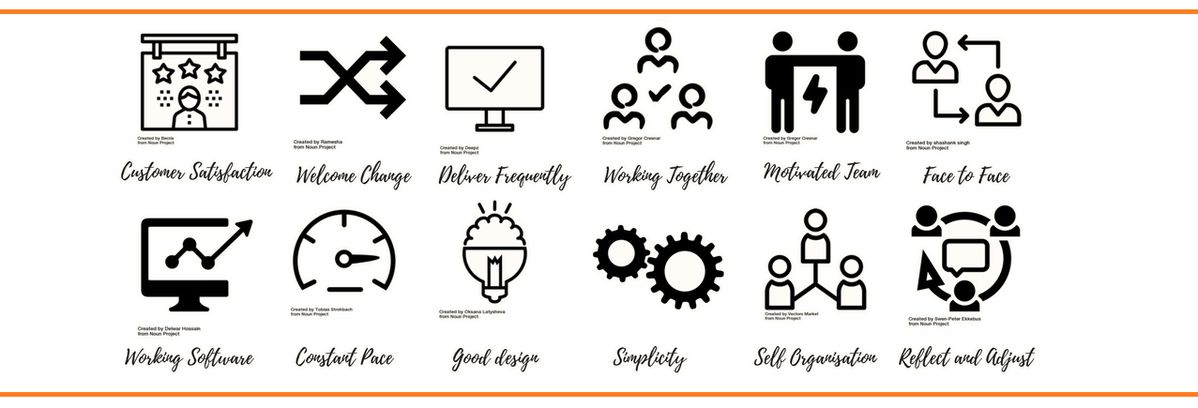
The 12 Agile Principles: What Every Nigerian Project Manager Must Know
The Agile Manifesto was written in 2001 by seventeen software experts. It contains four values and twelve principles. Lagos Data School teaches every principle to Nigerian project management students. Therefore, this guide explains each principle in plain, short language.

Also, each principle is linked to a Nigerian work example. By the end, you will understand Agile well enough to apply it from day one.
The Four Core Agile Values
Before the twelve principles, the Manifesto states four core values. Each value places one thing above another. However, Agile does not reject the less-valued items. Instead, it simply prioritises the more valuable ones.
| Agile Values This More… | …Than This |
| Individuals and interactions | Processes and tools |
| Working software | Comprehensive documentation |
| Customer collaboration | Contract negotiation |
| Responding to change | Following a fixed plan |
According to the official Agile Manifesto, these values guide the twelve principles. Furthermore, understanding the values helps you apply the principles correctly.
Principles 1 to 3: Deliver Value to the Customer
Principle 1: Deliver Working Products Early and Often
Agile teams deliver working results early and keep delivering continuously. In fact, early delivery is the number one goal of every Agile team. For example, a Lagos fintech team releases a basic payment feature in week two. Consequently, customers test and give feedback right away. Therefore, the next sprint is shaped by real users rather than assumptions. In short, early delivery builds client trust faster than any status report.
Principle 2: Welcome Changing Requirements
Agile teams welcome change even late in the project. In fact, this flexibility gives clients a real competitive advantage. For example, a client asks to add USSD support midway through an app build. Therefore, an Agile team adds it to the backlog and includes it in the next sprint.
As a result, scope flexibility becomes a feature rather than a problem. However, this only works when change requests go through the product owner first.
Principle 3: Deliver Working Products Frequently
Teams should ship a working product every one to four weeks. In addition, short delivery cycles beat long ones every time. For example, a two-week sprint keeps a Lagos development team focused and accountable.
Moreover, clients see real progress regularly rather than waiting months for a demo. Consequently, trust between the client and the team grows with every sprint.
Principles 4 to 6: Build Great Teams
Principle 4: Business and Developers Must Work Together Daily
Product owners and developers must talk every single working day. In fact, silos between business and tech are one of the main reasons projects fail. For example, a product manager at an Abuja startup joins the daily stand-up every morning. Therefore, business priorities are always clear to the development team.
As a result, the team builds the right things without waiting for weekly meetings.
Principle 5: Build Projects Around Motivated People
Great Agile teams need trust, support, and the right tools. Furthermore, micromanagement kills motivation and slows delivery. For example, a Lagos project manager gives the team autonomy over their own sprint plan. Consequently, ownership increases and output quality improves as well. Therefore, give your team what they need and then trust them to deliver.
Principle 6: Face-to-Face Conversation Is the Best Communication
Talking directly beats sending long emails every time. In fact, most project misunderstandings come from written messages without context. For example, sitting together in a Lagos co-working space beats a twenty-message WhatsApp thread.
Moreover, face-to-face conversations resolve conflict much faster. Therefore, Agile teams always prefer a quick call or meeting over a long document.
Principles 7 to 9: Focus on Quality and Pace
Principle 7: Working Software Is the Only True Measure of Progress
Status reports and slide decks do not prove progress. In fact, only a working product tells you where you truly stand. For example, a Lagos e-commerce team does not celebrate a design document. Instead, they celebrate when the checkout flow works and users can buy products. Therefore, always demo a working feature at the end of every sprint.
Principle 8: Maintain a Sustainable Development Pace
Agile teams work at a pace they can keep up indefinitely. In fact, burnout is one of the biggest killers of long-term team performance. For example, late-night coding every week hurts both quality and morale. Therefore, sprint planning must protect the team from unsustainable workloads. As a result, a well-paced team consistently outperforms an overworked one.
Principle 9: Continuous Attention to Technical Excellence
Clean code and good design keep teams fast. In contrast, technical shortcuts slow everything down over time. For example, a Port Harcourt software team refactors messy code every sprint. Consequently, adding new features becomes faster rather than harder as the project grows. Therefore, invest in code quality from sprint one rather than fixing it later.
Principles 10 to 12: Stay Simple and Keep Improving
Principle 10: Simplicity — Build Only What Is Needed
Agile teams build only what the client needs right now. In fact, extra features that no one asked for waste time and money. For example, a Lagos startup team resists adding a complex dashboard in sprint one. Instead, they focus on the core features that users actually need first. Therefore, every sprint item must be tied to a real user or business need.
Principle 11: Self-Organising Teams Produce the Best Results
The best work comes from teams that manage themselves. In fact, self-organising teams take ownership and deliver with more creativity. For example, a Lagos product team plans its own sprint tasks without waiting for assignments.
As a result, both team ownership and output quality rise significantly. Therefore, trust your team to manage their own work within the sprint boundaries.
Principle 12: Reflect and Improve at Regular Intervals
Teams must stop regularly to review how they are working. In fact, continuous improvement is at the heart of Agile.
For example, a Lagos Scrum team holds a retrospective at the end of every sprint. Consequently, they identify three things to improve and act on them immediately. Therefore, every sprint produces better results than the one before it.
All 12 Agile Principles at a Glance
Use this quick reference table in your daily project work.
| # | Principle | Nigerian Example |
| 1 | Deliver value early and continuously | Release features every sprint in Lagos |
| 2 | Welcome changing requirements | Add USSD support mid-sprint without drama |
| 3 | Deliver working products frequently | Ship every two weeks, not every six months |
| 4 | Business and dev collaborate daily | Product manager joins the daily stand-up |
| 5 | Build around motivated individuals | Give the team autonomy over sprint planning |
| 6 | Prefer face-to-face communication | Talk directly rather than sending long emails |
| 7 | Working product = real progress | Demo a live feature, not a slide deck |
| 8 | Maintain a sustainable pace | Protect the team from late-night sprints |
| 9 | Focus on technical excellence | Refactor code every sprint in Port Harcourt |
| 10 | Simplicity — build only what is needed | Skip the complex dashboard in sprint one |
| 11 | Self-organising teams deliver the best work | Team plans its own tasks without micromanagement |
| 12 | Reflect and improve at regular intervals | Retrospective every two weeks in Lagos |
Why These Principles Matter for Nigerian Project Managers
Many Nigerian teams adopt Agile tools like Trello or Jira without understanding the principles. Consequently, they get frustrated when the tools do not solve their deeper problems. However, when teams understand the principles first, the tools make complete sense. Therefore, memorising these twelve principles gives you the foundation for every Agile decision.
In addition, PMP and PMI-ACP exams both test your ability to apply these principles in context. As a result, learning the principles is both a career investment and a certification shortcut.
Common Mistakes Nigerian Teams Make with the Agile Principles
Mistake 1: Treating Stand-Ups as Status Meetings
Many Nigerian teams turn the daily stand-up into a long status update. However, Principle 6 says that communication should be short and direct. Therefore, keep the stand-up to ten minutes and three questions only.
Mistake 2: Skipping the Retrospective
Some Nigerian teams skip the retrospective when they are busy. However, Principle 12 says regular reflection is not optional. Consequently, teams that skip retrospectives repeat the same mistakes every sprint. Therefore, protect the retrospective even on busy sprints.
Mistake 3: Ignoring Technical Debt
Many Nigerian developers skip Principle 9 and ship fast without refactoring. As a result, the codebase becomes harder to change with every sprint.
Therefore, set aside at least ten percent of every sprint for code quality work.
Free Resources to Learn More About Agile Principles
Lagos Data School recommends the official Agile Manifesto as a first read. It is free, short, and written by the people who created Agile.
Also, the Scrum Guide by Schwaber and Sutherland is the official free Scrum reference. Furthermore, it maps directly to PMP and PMI-ACP exam content. In addition, Lagos Data School provides notes and exercises on all twelve principles in class.
How Lagos Data School Teaches the 12 Agile Principles
Lagos Data School covers every principle in its live Agile module. Students apply each principle to Nigerian project scenarios in group exercises. Moreover, the course links every principle to a real Scrum ceremony or practice. For example, Principle 12 is practised through a live sprint retrospective exercise.
Therefore, students leave knowing exactly how to apply Agile on a real Nigerian project.
Visit the Lagos Data School training page to enrol. Also, see what graduates have built at the Lagos Data School student portfolio.
Frequently Asked Questions: The 12 Agile Principles
Q1: Do I need to memorise all 12 principles for the PMP exam?
The PMP exam tests your ability to apply the principles, not recite them. Therefore, understanding each principle in context matters more than memorising words. In fact, practising scenario-based questions is far more effective for exam preparation.
Q2: Which principle is hardest for Nigerian teams to follow?
Principle 11 self-organising teams is often the hardest in Nigerian workplaces. In fact, many Nigerian organisations have a strong top-down management culture.
However, teams that adopt self-organisation consistently outperform those that do not. Therefore, Lagos Data School spends extra time on this principle in every training session.
Q3: Can non-tech Nigerian teams apply these principles?
Yes. Every principle applies to any team that plans and delivers work. For example, Nigerian marketing, HR, and events teams all use these principles successfully.
In addition, Agile principles work for government project teams as well. Therefore, the principles are universal — not just for software developers.
Q4: How long does it take to learn Agile principles fully?
You can read and understand all twelve principles in under one hour. However, applying them confidently on a real project takes two to four sprints of practice. Consequently, Lagos Data School combines classroom teaching with live project exercises.
As a result, students leave training ready to apply Agile on day one.
Master Agile Principles with Lagos Data School
The twelve Agile principles are not just theory. In fact, they are the daily habits of the world’s most effective project teams. Lagos Data School teaches you to apply every principle in real Nigerian projects.
Moreover, every session uses Nigerian case studies so that the learning is immediately practical.
Visit Lagos Data School and enrol in the project management course today.