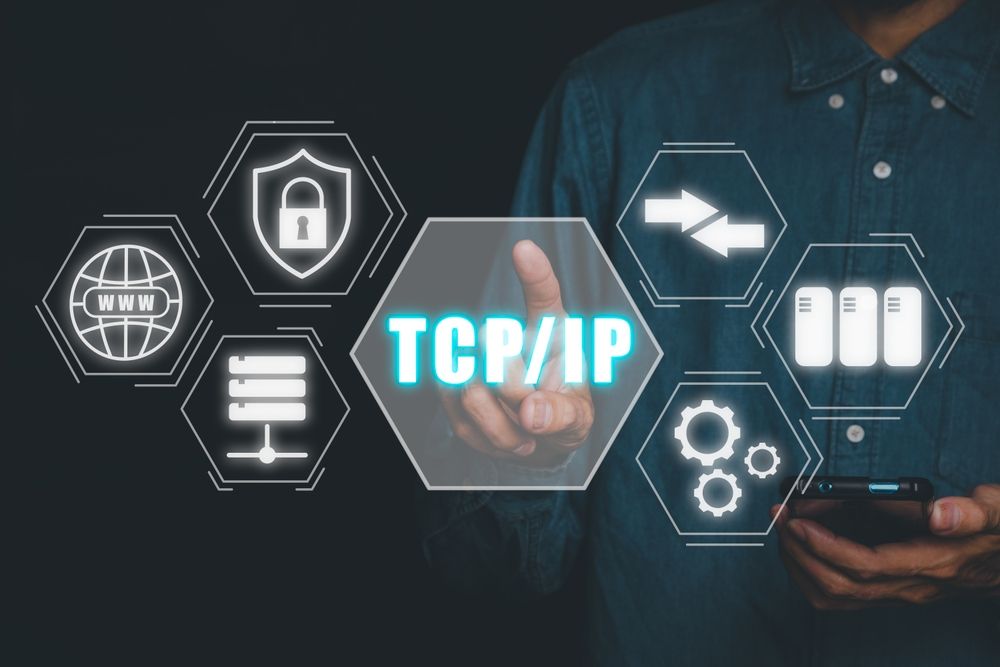
Every email you send, every site you visit, and every file you share moves through a system called TCP/IP. Most staff never think about it. But hackers think about it all the time.
This guide breaks down what TCP/IP is, how its layers work, and where hackers most often strike within this stack. You will also learn clear steps to guard each layer well.
Lagos Data School made this guide as part of our hands-on cyber course. Indeed, TCP/IP forms the base of much of what we teach. So let’s break it down in plain, clear terms.
What Is TCP/IP?
TCP/IP stands for Transmission Control Protocol and Internet Protocol. Together, these two parts form the core rule set that lets devices talk to each other across the internet.

Think of TCP/IP as the postal system for digital data. Your data gets broken into small parts, each one placed in its own digital envelope. TCP/IP makes sure each part reaches the right place, in the right order, without harm.
Without this system, the internet as we know it would not work at all. Every device — from your phone to a bank’s main server — relies on this same shared set of rules to talk and share data.
The Four Layers of the TCP/IP Stack
TCP/IP is built in layers, much like a cake. Each layer has its own job, and each one can also become a target for a hacker who knows where to look.
1. Network Access Layer
This is the bottom layer. It deals with the raw, physical link between devices — cables, Wi-Fi signals, and the gear that moves data from one point to the next.
Hackers can target this layer through physical access, such as tapping into a cable or setting up a fake Wi-Fi spot. So physical safety, like locked server rooms, plays a real role here too.
2. Internet Layer
This layer handles how data finds its way from one device to another, often across many networks at once. It uses IP addresses to mark where data should go.
A common attack at this layer is IP spoofing, where a hacker fakes their address to trick a system into trusting them. Firewalls and strong routing rules help guard this layer well.
3. Transport Layer
This layer makes sure data arrives whole and in the right order. It uses TCP for careful, checked delivery, and a faster but less careful method called UDP for some tasks.
Hackers often target this layer with SYN flood attacks, where they send a flood of fake connection requests to tie up a server’s resources. This can lead straight into a DDoS event if left unchecked.
4. Application Layer
This top layer is what most users see and use directly — web pages, email, and file transfers. It is also the layer most often hit by everyday attacks, since it deals directly with user input.
Common attacks here include fake login pages, harmful file uploads, and tricks aimed at web forms. Since staff interacts with this layer the most, staff training matters a great deal at this level.
Furthermore, this is the layer where most Nigerian staff spend nearly all of their working day, whether checking email, filling out forms, or browsing the web for work tasks. As a result, it often becomes the easiest target for hackers, since they only need to fool one person, not break through any deep, technical wall.
Why Hackers Target the TCP/IP Stack
Hackers go after TCP/IP because it forms the base of nearly all digital work. A flaw at any layer can open a door into systems that may seem safe on the surface.
Furthermore, many older systems still run on TCP/IP rules set decades ago, long before today’s threats existed. As a result, some weak points are baked into the very design of the system itself, not just poor setup choices.
Also, since TCP/IP touches every part of a network, a single weak point can give a hacker a path to move from one system to another with ease, once they get a foot in the door.
Common TCP/IP-Based Attacks in Nigeria
Nigerian firms face several common attack types tied directly to weak points in the TCP/IP stack. Knowing each one helps your team build the right defense.
IP Spoofing
In this attack, a hacker sends data with a fake source address, making it look like it comes from a trusted system. This trick can fool weak filters into letting harmful traffic through.
Man-in-the-Middle Attacks
Here, a hacker sits between two devices that are talking to each other, quietly reading or changing the data as it passes by. Public Wi-Fi in busy Lagos spots makes this attack far easier to pull off.
Port Scanning
Before an attack, hackers often scan a system to find open ports, which act like open doors into a network. Each open port found gives the hacker a possible way in to try next.
SYN Flood Attacks
As noted above, this attack floods a server with fake connection requests. The server holds each request open, waiting for a reply that never comes, until it runs out of room for real users.
How to Defend Each Layer of the Stack
Strong TCP/IP security comes from guarding each layer with the right tools and habits. Here is what Lagos Data School recommends as a base plan.
- Lock down physical access to cables, routers, and server rooms
- Use strong, updated firewalls to filter traffic at the network layer
- Turn on rate limiting to guard against SYN flood attacks at the transport layer
- Train staff to spot fake logins and harmful links at the application layer
- Use encryption, such as HTTPS, to protect data as it moves between layers
- Run regular port scans yourself to find and close open doors before hackers do
The Role of Encryption in TCP/IP Security
Encryption plays a key role in keeping TCP/IP traffic safe as it moves from point to point. Without it, data travels in plain form, which means anyone who taps into the flow can read it with ease.
Tools like TLS, which sits behind the lock icon you see in your browser, wrap your data in a layer of code that only the right party can unlock. This stops many man-in-the-middle attacks before they can do real harm.
So always check that your firm’s web tools and apps use strong encryption by default, not as an afterthought added later.
TCP/IP Security and the Rise of IoT in Nigeria
More Nigerian homes and firms now use smart devices — cameras, locks, and even fridges that connect to the internet. Each of these devices also runs on the same TCP/IP rules, which means each one can become a weak point too.
Sadly, many of these smart devices ship with weak default settings, and some users never change them. As a result, a single unguarded smart camera can become a hacker’s way into a much larger, more sensitive network.
Lagos Data School covers this growing risk in our cyber course, since the line between traditional IT gear and smart home or office devices keeps blurring more each year.
Why This Matters for Nigerian IT Careers
A real grasp of TCP/IP forms the base for nearly every other skill in network security. Firewalls, IDS tools, and even cloud setups all sit on top of this same shared system.
So IT staff who truly understand this stack tend to solve problems faster and explain issues more clearly to others on their team. This makes TCP/IP one of the most valuable base skills any Nigerian IT pro can build early in their career.
Recommended External Resource
For a deep, official guide on the TCP/IP model, visit the Internet Engineering Task Force’s RFC index: https://www.ietf.org/standards/rfcs/
A Closer Look at the OSI Model vs TCP/IP
Many IT courses also teach a related idea called the OSI model, which splits networking into seven layers instead of four. Students often ask how this fits with TCP/IP, so let us clear that up here.
The OSI model came first, as a teaching tool meant to explain networking in clear, separate steps. TCP/IP came later and became the model the real world actually adopted and built upon at scale.
In short, TCP/IP groups some of the OSI layers together into broader, more practical groups. Many of its four layers map roughly onto two or three OSI layers each. So while the names and counts differ, the core ideas stay closely linked.
Lagos Data School teaches both models side by side, since job interviews and real-world work often reference each one at different times, depending on the firm and the role.
So do not worry if your first IT course taught you the seven-layer OSI model, while a job posting later asks about the four-layer TCP/IP stack. Both describe much of the same underlying system, just sliced into a different number of named parts.
Real Tools Used to Inspect TCP/IP Traffic
Beyond theory, Nigerian IT staff also need real, hands-on tools to study and guard TCP/IP traffic on a live network. Here are a few that Lagos Data School covers in our labs.
- Wireshark for viewing live traffic at a deep, packet-by-packet level
- Nmap for scanning networks and finding open ports across the stack
- Netstat, a built-in tool on most systems for checking active connections
- Tcpdump, a command-line tool often used on servers to capture traffic
Learning to use these tools well takes real practice, not just reading about them. So Lagos Data School builds hands-on lab time into every module that touches TCP/IP, since theory alone rarely sticks without practice behind it.
Building Strong TCP/IP Habits Across Your Team
Beyond tools, real safety comes from habits that your whole team shares. Make it normal to question odd network behavior, rather than brushing it off as a small glitch.
Also, keep a simple, written record of your network’s normal traffic patterns. This record helps your team spot what counts as truly odd far faster, since you have a clear point of comparison to check against.
Finally, revisit your TCP/IP defense steps at least once a year, since both your gear and the threats you face will keep changing over time. Lagos Data School builds this habit of steady review into every course we run, since strong skills fade fast without regular use.
TCP/IP Security Checklist for Nigerian IT Teams
Before you close this guide, run through this short checklist to see where your firm stands today on TCP/IP security.
- Do you have firewalls actively filtering traffic at the network layer?
- Have you closed or hidden any open ports you do not actively use?
- Does your firm use HTTPS and other encryption across all web traffic?
- Do staff know how to spot a fake login page or harmful link?
- Have you run a port scan on your own network within the last month?
If you answered no to two or more of these, treat TCP/IP security as a near-term priority. Lagos Data School built this checklist from real gaps we often find when training new IT staff across Nigerian firms.
About Lagos Data School
Lagos Data School is Nigeria’s top school for cybersecurity, data science, cloud, and analytics. Every idea in this guide is part of our hands-on course.
Our teachers are real security pros, not just classroom staff. So you learn from people who guard live networks every day.
We run classes on weekdays, weekends, and online. So no matter your time, we have a slot for you. Beyond skills, we also give you a real certificate and links to job partners.
Visit Lagos Data School today to view our courses and join the next class.
Master the stack. Train with Lagos Data School.